Highlights from Sacred Destinations
Explore the site
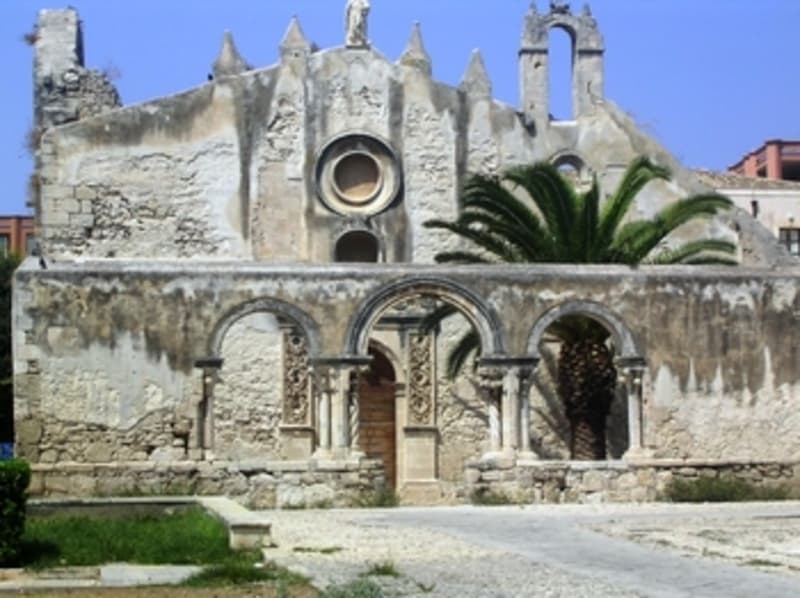
All that remains of the church today are roofless Norman walls and about half of the former apse, both overgrown.
/ Italy / Catacombs of St. John
St. John
This extensive complex of early Christian tombs is entered through the ruins of a 12th-century Norman church. Some ancient frescoes can still be seen in the catacombs.
The Catacombs of St. John in Siracusa contain some 20,000 Early Christian tombs - honeycombed tunnels of empty coffins that were long ago looted of their "burial riches" by plundering grave robbers. They are entered through the evocative ruins of a Norman church.
In Roman times, Christians were not allowed to bury their dead within the city limits, so they went outside the boundaries of Syracuse to create burial chambers in what had been used by the Greeks as underground aqueducts. The early Christians recycled these into chapels.
Syracuse has other subterranean burial grounds, but the Catacombs of St. John are the only ones open to the public. You enter the "world of the dead" from the Chiesa di San Giovanni, now a ruin. St. Paul is said to have preached on this spot, so the early Christians venerated it as holy ground.
The church's roots go back to the 6th century, when a basilica stood here, but it was eventually destroyed by the Saracens. The Normans reconstructed it in the 12th century and it served as the cathedral of Syracuse, but in 1693 an earthquake destroyed it. A baroque church was then built, but was abandoned in the 17th century and left in ruins by the earthquake of 1908.
The Normans reconstructed it in the 12th century and it served as the cathedral of Syracuse, but in 1693 an earthquake destroyed it.
A baroque church was then built, but was abandoned in the 17th century and left in ruins by the earthquake of 1908.
All that remains of the church today are roofless Norman walls and about half of the former apse, both overgrown. A beautiful rose window is still visible on the facade.
Underneath the church is the Cripta di San Marciano (Crypt of St. Marcian), constructed on the spot where the martyr is alleged to have been beaten to death. His Greek-cross chamber is found 5m (16 ft.) below the ground.
Some faded frescoes and symbols etched into stone slabs can still be seen in the catacombs.
Highlights from Sacred Destinations
Highlights from Sacred Destinations
Advertisement
Advertisement
Advertisement
Where on earth