Highlights from Sacred Destinations
Explore the site
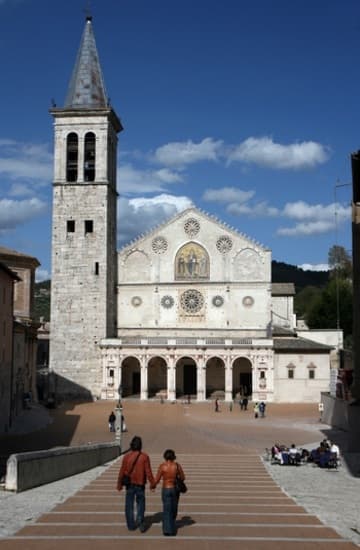
Spoleto's Duomo is at the bottom of a monumental staircase on the Piazza del Duomo , backed by a forested green hill.
/ Italy / Spoleto Cathedral
Virgin Mary (Assumption) · 1160-98
The lovely Duomo di Spoleto dates from the 12th century. It features a fine Romanesque facade, magnificent frescoes by Fra Filippo Lippi and others, and a handwritten letter from St. Francis of Assisi.
The Duomo of Spoleto, dating from the 12th century, features a lovely Romanesque façade and a magnificent fresco cycle by Fra Filippo Lippi. Its official name is Cattedrale di Santa Maria Assunta(Cathedral of the Assumption of St. Mary).
The cathedral was built to replace a church razed by Frederick Barbarossa in 1155, when the emperor destroyed Spoleto for refusing to pay him tribute. The new cathedral was consecrated by Pope Innocent III in 1198.
The Life of the Virgin fresco cycle in the apse was begun by Fra Filippo Lippiin 1467. The work was almost finished when the master died suddenly in 1469; his assistants finished it up a few months later on his behalf.
The Duomo contains the tomb of Filippo, but his remains have been lost. The tomb was designed by his son, Filippino, at the request of Lorenzo de' Medici. Lorenzo was unable to convince the Spoleteans to give Filippo's body to Florence to be honored there.
The Duomo's interior was fully baroqued in the 17th century for Pope Urban VII, who's commemorated with a Gian Lorenzo Bernini bust high above the central door inside. Only the pavement and frescoes survived this renovation.
The cathedral was built to replace a church razed by Frederick Barbarossa in 1155, when the emperor destroyed Spoleto for refusing to pay him tribute.
The new cathedral was consecrated by Pope Innocent III in 1198 .
Spoleto's Duomo is at the bottom of a monumental staircase on the Piazza del Duomo, backed by a forested green hill. It makes a fitting stage for the Spoleto Festival finale and, on a more daily basis, a soccer field for local children.
A 3rd-century Roman sarcophagus serves as a public fountain at the base of the stairs. On the left of the square is the small, octagonal-roofed Church of Santa Maria della Manna d'Oro (the Duomo sacristan will sometimes unlock it on request).
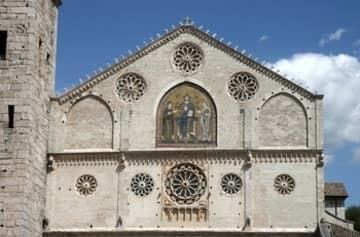
The Duomo's unique Romanesque façade features a golden mosaic dated 1207 and signed by a certain Solsternus. It depicts Christ between the Virgin Mary and St. John. Also decorating the facade are no less than eight rose windows; the central one is surrounded by small atlantes sculptures and symbols of the Four Evangelists.
The attached bell tower was built of stone from Roman temples (some ancient reliefs can be seen among the masonry), while the open portico is a Renaissance addition (1492).
Inside, the Romanesque architecture has been given a white Baroque makeover. The first chapel on the right has a fresco of the Madonna and Child (1497) by Pinturicchio. A coin-operated light illuminates this fresco and the early-16th-century frescoes in the chapel next door.
The right transept is home to a Madonna and Child with Saints (1599) by Baroque master Annibale Carracci and houses the empty tomb of Filippo Lippi, designed by his son Filippino.
The 12th-century apse is beautifully decorated with the 15th-century Life of the Virgin fresco cycle by Filippo Lippi. It is divided into four scenes: the Annunciation on the left; the Dormition of the Virgin in the center with the Coronation of the Virgin above; and the Nativity on the right. The first three were painted almost entirely by the master himself; only the Nativity contains significant work by his assistants.
The Coronation of the Virgin in the apse commands the most attention, with bright jewel tones and dynamic action. Mary is shown being crowned by God himself (instead of the more usual depiction with Christ), watched by saints, angels and Old Testament figures gathered around a rainbow.
The Dormition of the Virgin fresco contains several personal portraits, including one of the artist himself. Filippo is the man in the black hat, turned toward the viewer and wearing a white monk's habit with a black hat. Portraits of his assistants Fra' Diamante and Pier Matteo d'Amelia are behind him and the angel holding a candle in the front is Lippi's 11-year-old son Filippino, also a talented painter.
The Cappella delle Reliquie (Reliquary Chapel) in the left aisle was restored in 1993 and should not be missed. Its relics include 16th-century intarsia wood cupboards, a 14th-century painted wooden Madonna and Child, and a letter written and signed by St. Francis. Only two known signatures of the saint have survived - Assisi has the other one.
The altar at the back of the left aisle by the entrance contains a brightly painted Romanesque crucifix, signed in 1187 by Alberto Sotio - the earliest Umbrian painter known by name. The scene includes miniature portraits of the Virgin Mary and St. John; medieval theology is represented by the blood from Christ's wounds running into the skull of Adam at the bottom.
Highlights from Sacred Destinations
Highlights from Sacred Destinations
Advertisement
Advertisement
Advertisement
Where on earth