Highlights from Sacred Destinations
Explore the site
Aside from its historic interest, Il Ghetto is also one of the less touristy neighborhoods in Venice (though it is becoming somewhat of a nightspot) and is a pleasant place for a stroll.
/ Italy / Jewish Ghetto
Sacred site · 1516
This is the area of Venice in which all Jews were forced to live from the 16th to the 18th century, as described in The Merchant of Venice . It is home to several synagogues and a Jewish museum.
Il Ghetto (the Jewish Ghetto) in Venice is the area in which all Jews were forced to live from the 16th to the 18th century. Made famous by Shakespeare's Merchant of Venice, the Venice Ghetto is now a pleasant neighborhood where Venice's small Jewish community still lives. It also the home of a Jewish museum, the Museo Communità Ebraica.
Venice's relationship with its longtime Jewish community fluctuated over time from acceptance to tolerance, with attitudes often influenced by the fear that Jewish moneylenders and merchants would infiltrate other sectors of the republic's commerce under a government that thrived on secrecy and control.
In 1516, seven hundred Jews were forced to move to this part of Venice, then an abandoned site of a 14th-century foundry that produced cannons. The word "ghetto," soon used throughout Europe for the neighborhoods of isolated minority groups, originated in Venice: geto is old Venetian dialect for "foundry."
Like most of the islands that make up Venice, the ghetto was totally surrounded by water. Its two access points were controlled at night and early morning by heavy gates manned by Christian guards (paid for by the Jews), both protecting and segregating its inhabitants.
Within one century, the community grew to more than 5,000, representing many languages and cultures. Although the original Ghetto was periodically expanded, land was limited and quarters always cramped.
With the arrival of Napoléon in 1797, the ghetto was disbanded and Jews were free to move wherever they liked, but the Jews realized full freedom only in the late 19th century with the founding of the Italian state.
On the eve of World War II there were about 1,500 Jews left in the ghetto. During the Holocaust, 247 Venetian Jews were deported by the Nazis; only eight returned. The Nazis gathered Jews for deportation in the square next to the Casa di Riposo Israelitica.
Today, the historic ghetto remains the center of Venice's ever-diminishing Jewish community; between 500 and 2,000 Jews now live in Venice.
During the Holocaust, 247 Venetian Jews were deported by the Nazis; only eight returned.
Today, the historic ghetto remains the center of Venice's ever-diminishing Jewish community; between 500 and 2,000 Jews now live in Venice.
Aside from its historic interest, Il Ghetto is also one of the less touristy neighborhoods in Venice (though it is becoming somewhat of a nightspot) and is a pleasant place for a stroll.
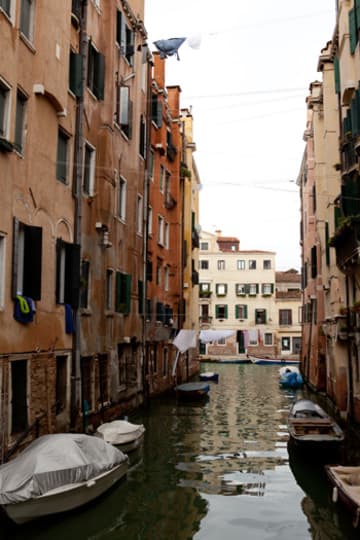
The ghetto consists of an open square surrounded by "skyscrapers" on three sides. The lack of space in the ghetto resulted in many buildings having as many as seven stories (with no elevator).
Venetian laws forbade the building of separate synagogues, so the synagogues were built on the top floors of the buildings - Jewish law says there should be no obstructions between the congregation and the heavens. Frequent tours of three of the five synagogues are given by the nearby Museo Communità Ebraica.
On both sides of the Casa di Riposa building are Holocaust memorials designed by sculptor Arbit Blatas. One of the monuments is a bronze panel depicting the Last Train, the other monument has bronze reliefs that show the Nazi brutality against the Jews.
Venice's first kosher restaurant, Gam Gam, recently opened on Fondamenta di Cannaregio 1122 (tel. 041-715-284) near the entrance to the Jewish Ghetto and close to the Guglie vaporetto stop. Owned and run by Orthodox Jews from New York, it serves lunch and dinner Sunday through Friday, with an early Friday closing after lunch.
Highlights from Sacred Destinations
Highlights from Sacred Destinations
Advertisement
Advertisement
Advertisement
Where on earth