Highlights from Sacred Destinations
Explore the site
Today, the lotus ponds, arched bridge, contented pigeons, and bright sheen of the shrine give little clue to its sometimes violent feudal history.
/ Japan / Tsurugaoka Hachimangu
Hachiman · founded c.1190
Kamakura's most important Shinto shrine, dedicated to the god of war. Its peaceful and scenic grounds give no indication of its violent history of feudal warring.
Dating from the 12th century, Tsurugaoka Hachimangu Shrine is the spiritual heart of Kamakura and one of its most popular attractions.
The shrine was originally founded by Minamoto Yoriyoshi in 1063, then enlarged and moved to its present site by Minamoto Yoritomo, the first shogun of the Kamakura government, in 1180. The shrine was dedicated to Hachiman, the Shinto god of war and patron of the Minamoto family.
Wakamiya Oji, the cherry tree-lined pedestrian path to the shrine, was constructed by Yoritomo in the 1190s so that his oldest son's first visit to the family shrine could be accomplished in style with an elaborate procession.
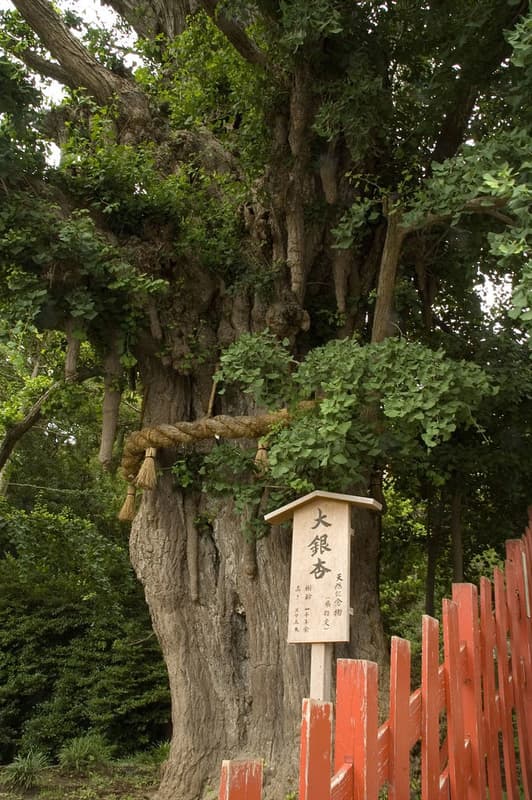
A gingko tree to the left of the stairs to the shrine (believed to be about 1,000 years old) is the traditional site of a vicious act of feudal violence in 1219. Here, Yoritomo's second son was ambushed and brutally murdered - his head was never found. Fearful this might signify plans for a coup, Yoritomo ordered his brother killed, but the brother committed seppuku before it could be carried out. Finally, to fully eliminate all possible threats to the shogunate, the baby boy of the brother's mistress was killed.
The shrine was originally founded by Minamoto Yoriyoshi in 1063, then enlarged and moved to its present site by Minamoto Yoritomo, the first shogun of the Kamakura government, in 1180 .
The shrine was originally founded by Minamoto Yoriyoshi in 1063, then enlarged and moved to its present site by Minamoto Yoritomo, the first shogun of the Kamakura government, in 1180 .
Today, the lotus ponds, arched bridge, contented pigeons, and bright sheen of the shrine give little clue to its sometimes violent feudal history. The tree-lined pedestrian lane stretches from the shrine all the way to Yuigahama Beach, with three massive torii set at intervals along the route to signal the approach to the shrine. On both sides of the pathway are souvenir and antiques shops selling lacquerware, pottery, and folk art.
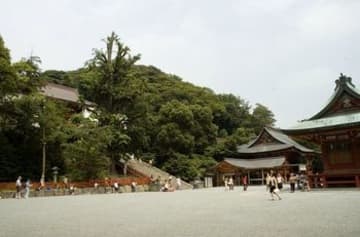
The shrine is located at the top of 62 steps. At the top of the stairs, from which there is a panoramic view toward the sea, is the shrine itself. The red-painted building isn't terribly notable - the grounds are the major attraction here.
Highlights from Sacred Destinations
Highlights from Sacred Destinations
Advertisement
Advertisement
Advertisement
Where on earth