Highlights from Sacred Destinations
Explore the site
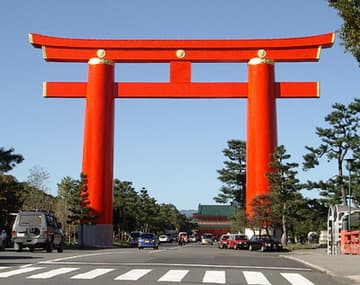
Outside the shrine and arching over a busy road is the torii (shrine gate) of Heian Jingu, the largest in Japan.
/ Japan / Heian Jingu
Sacred site
An imperial Shinto shrine built in 1895 in honor of the founding of Kyoto.
The Heian Jingu is an imperial Shinto shrine in Kyoto, Japan. One of the newest religious sites in Kyoto, it boasts the largest torii (sacred gate) in Japan and lovely gardens.
Heian Jingu was built in 1895 to celebrate the 1100th anniversary of the establishment of Heian-kyo (the old name of Kyoto). The Shinto shrine honors two emperors: Kammu (737-806), who founded Kyoto in 794, and Komei (1831-66), the last emperor to live out his reign in Kyoto before the capital moved to Tokyo.
On the occasion of the deification of Emperor Komei in 1940, additional buildings were added, including the Main Sanctuary, Shinto ritual hall, Inner Sanctuary, Flank Hall, Tablet Hall, Outer and Inner Platforms, Saikan and Administration Building.
The Shinto shrine honors two emperors: Kammu (737-806), who founded Kyoto in 794, and Komei (1831-66), the last emperor to live out his reign in Kyoto before the capital moved to Tokyo .
The Shinto shrine honors two emperors: Kammu (737-806), who founded Kyoto in 794, and Komei (1831-66), the last emperor to live out his reign in Kyoto before the capital moved to Tokyo .
Outside the shrine and arching over a busy road is the torii (shrine gate) of Heian Jingu, the largest in Japan. Built in 1929, it is 24.2 meters high; the top rail is 33.9 meters long.
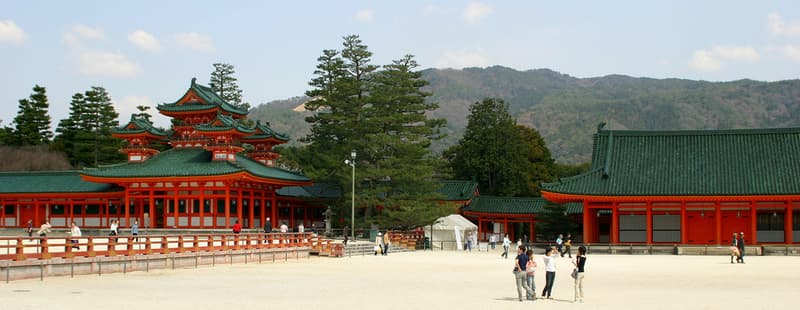
The orange, green, and white buildings of Heian Jingu are intended to be replicas of the old Kyoto Imperial Palace (destroyed in 1227), at two-thirds the original size. The main buildings are the dignified East Hon-den and West Hon-den (the Main Halls), and the Daigoku-den (Great Hall of State), in which the Heian emperor would issue decrees.
There are three stroll gardens at Heian Jingu, positioned east, west, and north of the shrine itself. They follow the Heian aesthetic of focusing on a large pond, which is a rare feature at a Shinto shrine. The stepping-stone path that crosses the water is made from the pillars of a 16th-century bridge that spanned the Kamo-gawa before an earthquake destroyed it.
Shinen Garden, which is entered on the left as you face the main hall, should especially not be missed. Typical of gardens constructed during the Meiji Era, it's famous for its weeping cherry trees in spring, its irises and water lilies in summer, and its changing maple leaves in the fall.
Highlights from Sacred Destinations
Highlights from Sacred Destinations
Advertisement
Advertisement
Advertisement
Where on earth