Highlights from Sacred Destinations
Explore the site
You enter the temple through the Sanmon (Triple Gate), the classic "gateless" gate of Zen Buddhism that symbolizes entrance into the most sacred part of the temple precincts.
/ Japan / Nanzenji
Sacred site
An important Rinzai Zen temple on the Path of Philosophy, Nanzenji has a beautiful Zen garden and extensive grounds.
Nanzenji (or Zuiryusan Nanzenji) is a Zen Buddhist temple in Kyoto, Japan. Emperor Kameyama established it in 1291 on the site of his palace, and it became one of the most important Rinzai temples in Japan.
Like the nearby temple of Ginkaku-ji, Nanzenji is a former aristocratic retirement villa that was turned into a temple on the death of its owner.
Emperor Kameyama (1249-1305) built his detached palace here in 1264. He later became a student of the Zen Master Busshin Daimin Kokushi, and he dedicated the palace as a Zen temple in 1291.
Nanzenji went on to become one of the Five Great Zen Temples of Kyoto. As the headquarters of the Nanzenji branch of the Rinzai school of Zen, it is also one of the most important Zen temples in the world. Throughout its history, the abbot of Nanzenji was always chosen as the best Rinzai Zen Master in each period.
Rinzai Zen was introduced to Japan by the Chinese priest Ensai in 1191 and emphasizes the use of koans, paradoxical puzzles or questions that help the practitioner to overcome the normal boundaries of logic.
The 15th-century Onin Civil War demolished the original temple buildings, but some were rebuilt during the 16th century. The temple's large entrance gate (Sanmon) was completed in 1628.
Rinzai Zen was introduced to Japan by the Chinese priest Ensai in 1191 and emphasizes the use of koans , paradoxical puzzles or questions that help the practitioner to overcome the normal boundaries of logic.
Emperor Kameyama (1249-1305) built his detached palace here in 1264.
You enter the temple through the Sanmon (Triple Gate), the classic "gateless" gate of Zen Buddhism that symbolizes entrance into the most sacred part of the temple precincts. The grand wooden structure was built in 1628 by Todo Takatora in memory of those who died in the civil war.
Don't miss the statue of Goemon Ishikawa, a Robin Hood-style outlaw of Japan who hid in this gate until his capture. From the top floor of the gate you can view Kyoto spread out below. The upper floor also contains Buddha statues and paintings.
Through the gate is the Hojo (Abbots' Quarters), a National Treasure. Inside, sliding doors (fusuma) with impressive 16th-century paintings divide the chambers. These wall panels of the Twenty-Four Paragons of Filial Piety and Hermits were created by Eitoku Kano (1543-90) of the Kano school.
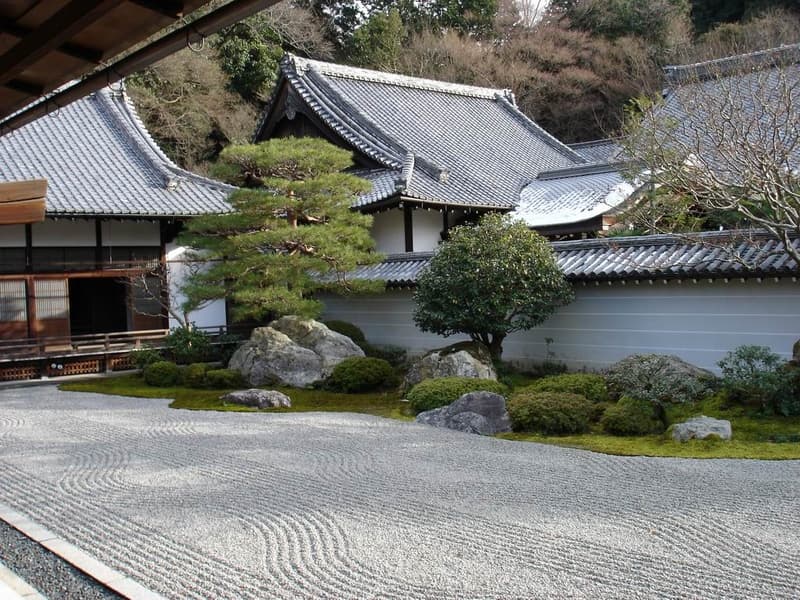
Attached to the Hojo is a Zen garden, known as the "Leaping Tiger Garden." An excellent example of the karesansui style (seen more famously at Ryoanji), the rock-and-gravel garden was created by Kobori Enshu. It has the unusual feature of having its large rocks grouped with clipped azaleas, maples, pines, and moss, all positioned against a plain white wall behind the raked gravel.
Within Nanzen-ji's 27 forested acres is an aqueduct built in 1890 and several other temples, known more for their gardens than for their buildings.
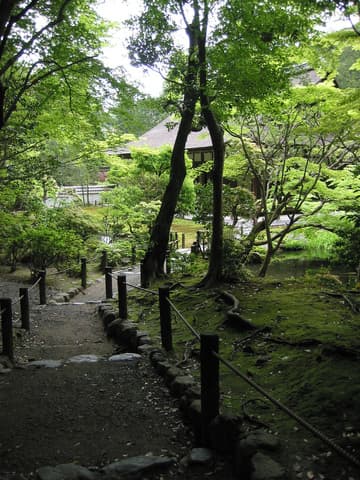
One temple worth visiting if you have time is Nanzen-in, directly behind the aqueduct. Nanzen-in is not as famous as other temples, making it a peaceful place to visit. Once the temporary abode of Emperor Kameyama, Nanzen-in has a mausoleum and a garden that dates from the 14th century; a small creek passes through it. The garden is particularly spectacular with autumn leaves.
Also worth a look is the rarely-visited Konchiin, southwest of the Sanmon gate.
Highlights from Sacred Destinations
Highlights from Sacred Destinations
Advertisement
Advertisement
Advertisement
Where on earth