Highlights from Sacred Destinations
Explore the site
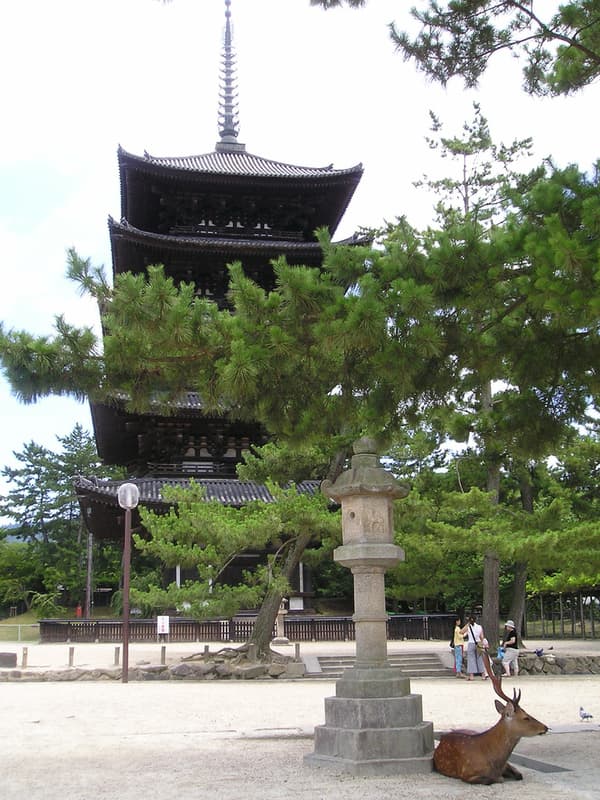
The Kofukuji complex includes two pagodas, located on either side of the southern entrance.
/ Japan / Kofukuji
Sacred site
This temple has two pagodas, one of which is the second-highest in Japan. Many Buddhist statues and artworks are on display in the Treasure House.
Kofukuji is a Hosso Buddhist temple in Nara, Japan. One of the great temples of the Nara period, it features a tall five-story pagoda and many Buddhist art treasures.
Kofukuji was one of the "Four Great Temples" of the Nara period (710-794). Founded in 669 AD by a member of the Fujiwara clan to pray for the clan leader to recover from illness, Kofukuji became the head temple of the Hosso sect of Buddhism.
Kofukuji was moved to its present location when Nara became the capital in the year 710. The temple prospered, but when the Fujiwaras' power faded in the 12th century, the temple lost its influential patrons and began to decline.
Today only a handful of the temple's 175 buildings remain standing, most of which date from the 15th century. Kofukuji was named a UNESCO World Heritage Site in 1998 along with other historic sites in Nara.
Today only a handful of the temple's 175 buildings remain standing, most of which date from the 15th century.
Founded in 669 AD by a member of the Fujiwara clan to pray for the clan leader to recover from illness, Kofukuji became the head temple of the Hosso sect of Buddhism.
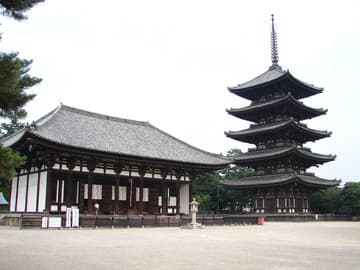
The Kofukuji complex includes two pagodas, located on either side of the southern entrance. The Three-Story Pagoda is on the west and the Five-Story Pagoda (Gojunoto) is on the east. The Five-Story Pagoda was built in 725 by the Empress Komyoh and last rebuilt in 1426. One of the symbols of Nara, it is the second highest pagoda in Japan (after Toji in Kyoto) with a height of 50.1 metters.
The Eastern Golden Hall (Tokondo) was originally constructed in 726 by Emperor Shomu to speed the recovery of the ailing Empress Gensho, and is dominated by a large image of Yakushi Nyorai (the Healing Buddha). Rebuilt in 1415, the Tokondo also houses a 12th-century wooden Monju (bodhisattva of wisdom), long worshipped by scholar monks and today by students; and guardians and assistants of Yakushi.
The temple's Treasure House (Kokuhokan) is one of the highlights, with displays of statues and artworks originally contained in the temple buildings. Among the most notable treasures are an 8th-century statue of Ashura (one of Buddha's eight protectors) carved in the 8th century, an even older bronze head of Yakushi Nyorai, and 12th-century carved wooden statues of priests with strikingly human facial features.
There are two octagonal buildings at Kofukuji: the Hokuendo (Northern Octagonal Hall) and the Nanendo (Southern Octagonal Hall). The Hokuendo was built in 721 by the Empress Gemmei and the Emperor Gensho in honor of the first anniversary of the death of Fujiwara Fuhito. The current building dates from 1210 and is only open during special periods in the spring and fall.
The Nanendo (Southern Octagonal Hall) is important because it is temple #9 on the West Japan 33-temple pilgrimage route. Founded in 813 by Fujiwara-no-Fuyutsugu, the present building dates from 1789.
Highlights from Sacred Destinations
Highlights from Sacred Destinations
Advertisement
Advertisement
Advertisement
Where on earth