Highlights from Sacred Destinations
Explore the site
Paul's Cathedral is a fine structure, designed by architect Lorenzo Gafa .
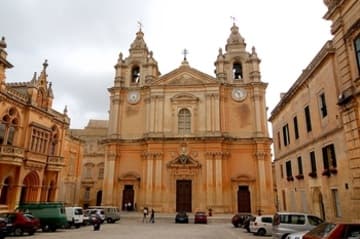
/ Malta / Mdina Cathedral
St. Paul · 17th C
This 17th-century cathedral stands on the traditional site of the town house of the governor Publius, who received the Apostle Paul when he was shipwrecked on Malta.
The late 17th-century St. Paul's Cathedral in Mdina stands on the traditional site of the house of the governor Publius, who received St. Paul when he was shipwrecked on Malta.
Acccording to the Book of Acts, Paul and his missionary party were shipwrecked on Malta for three months. During his stay, Paul was bitten by a snake and remained unharmed, prompting the natives to regard him as a god. He later healed the father of the governor of the island, Publius, and many other people (Acts 27:1-11).
According to tradition, Publius was converted to Christianity and went on to become the bishop of Malta and later of Athens. St. Paul's Cathedral stands on the traditional site of Publius' town house and headquarters.
The Cathedral of St. Paul was built from 1697 to 1702 to replace a Norman cathedral that had been destroyed by earthquake in 1693. The new cathedral caused a significant redesign of medieval Mdina's city center—several streets and houses were cleared to create an open square in front of the cathedral.
Paul was built from 1697 to 1702 to replace a Norman cathedral that had been destroyed by earthquake in 1693.
Paul was built from 1697 to 1702 to replace a Norman cathedral that had been destroyed by earthquake in 1693.
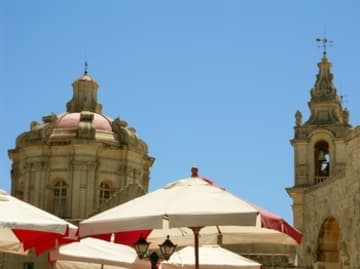
St. Paul's Cathedral is a fine structure, designed by architect Lorenzo Gafa. Its impressive façade wows visitors as they emerge from Mdina’s narrow streets. The cathedral's magnificent dome, with red-and-white stripes, dominates the skyline. The dome's interior has been decorated by a succession of painters; today’s decoration dates from the 1950s.
The lavish interior of the cathedral is similar in many ways to the Cathedral of St. John in Valetta. There are great works by the Calabrian artist and knight Mattia Preti and a marble-inlaid floor with tombstones carrying the coats of arms and inscriptions of the bishops of Mdina and other members of the cathedral chapter.
Surviving from the original Norman church is a monumental depiction of the conversion of St. Paul by Mattia Preti, between the apse and main altar. Also surviving from the old church are: the 15th-century Tuscan panel painting of the Madonna and Child; the baptismal font; the frescoes in the apse depicting St. Paul’s shipwreck; and the old portal, made of carved Irish bog wood, which now serves as a door to the vestry.
The cathedral's museum has a collection of coins, silver plate, religious vestments and some woodcuts by the German artist Albert Dürer.
Highlights from Sacred Destinations
Highlights from Sacred Destinations
Advertisement
Advertisement
Advertisement
Where on earth