Highlights from Sacred Destinations
Explore the site
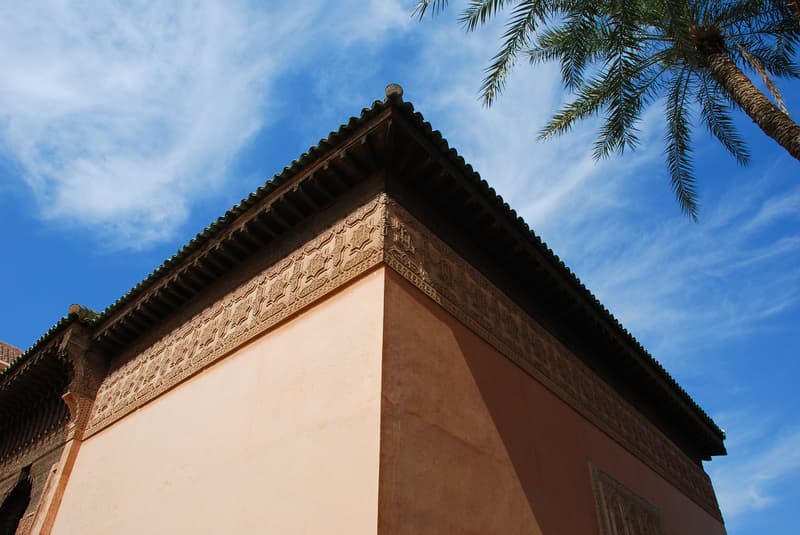
The enclosure consists of two main mausoleums, with 66 tombs laid out within them and over 100 more outside in the gardens.
/ Morocco / Saadian Tombs
Sacred site · In use 1557-1792
This site next to the old kasbah was used for burials throughout the Saadian period (beginning 1557), then sealed up for centuries. It contains two mausoleums and nearly 200 tiled tombs of royals.
The Saadian Tombs in Marrakesh were sealed up for centuries until their rediscovery in 1917. Occupying a quiet enclosure at the kasbah, the tombs are magnificently decorated with colorful tiles, Arabic script and elaborate carvings.
This site may have been a burial ground before the Saadian period, but the earliest known burial dates from 1557 and all the main buildings were constructed under Sultan Ahmed el Mansour (1578-1603). The site is contemporary with the Ben Youssef Medersa and the similarities between the two are evident.
When Moulay Ismail (1672-1727) took over in Marrakesh, he systematically destroyed the adjacent Badi Palace but superstition probably kept him from destroying the burial ground. Instead, he sealed up all the entrances to the Saadian Tombs except for an obscure one from the Kasbah Mosque.
Nevertheless, a few prominent citizens were buried here after it was sealed up: the last was the "mad sultan" Moulay Yazid in 1792, who ruled for 22 violent months. Immediately following his brutal suppression of a rebellion based in Marrakesh, he was shot in the head during a counterattack.
The Saadian Tombs lay hidden and mostly forgotten until 1917, when they were discovered during a French aerial survey and a passageway was built from the side of the Kasbah Mosque. The tombs' long neglect has ensured their preservation and they have since been fully restored to their original glory.
This site may have been a burial ground before the Saadian period, but the earliest known burial dates from 1557 and all the main buildings were constructed under Sultan Ahmed el Mansour (1578-1603).
This site may have been a burial ground before the Saadian period, but the earliest known burial dates from 1557 and all the main buildings were constructed under Sultan Ahmed el Mansour (1578-1603).
The enclosure consists of two main mausoleums, with 66 tombs laid out within them and over 100 more outside in the gardens. The first mausoleum, seen on the left as you enter, is the finest of the two. Built to house Mansour's tomb and completed during his lifetime, its vaulted roof, fine carvings and stunning zellij tiles recall the Alhambra in Granada (built 200 years earlier).
The first hall is an oratory and probably not originally intended for burial, but nevertheless contains the thin marble stones of several Saadian princes. Here also is the tomb of the mad Moulay Yazid, which ironically conflicts with the black-and-white script in the hall that reads, "And the works of peace they have accomplished will make them enter the holy gardens."
In the back of the mausoleum is a very fine mihrab, supported by a delicate group of columns. El Mansour's tomb is in the domed central chamber, flanked by the tombs of his sons and successors.
The second mausoleum is older but less impressive. It was built by Ahmed el Mansour in place of an existing pavilion over the tombs of his mother and of the founder of the Saadian dynasty, Mohammed ech Sheikh. The former is below the dome in the outer chamber; most of the latter is buried in the inner chamber (he was murdered in the Atlas mountains by Turkish mercenaries and his head was put on public display in Istanbul).
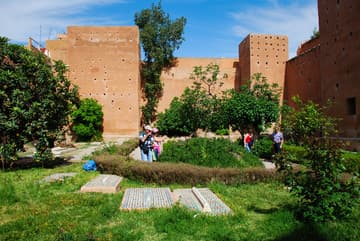
Scattered around the gardens are the tombs of over 100 more Saadian princes and members of the royal household, including a few Jewish graves. The gravestones are covered in brilliantly colored tiles and most have inscriptions with epitaphs and quotes from the Qur'an. Most simply read:
Carved on the walls is the following poem:
Highlights from Sacred Destinations
Highlights from Sacred Destinations
Advertisement
Advertisement
Advertisement
Where on earth