Highlights from Sacred Destinations
Explore the site
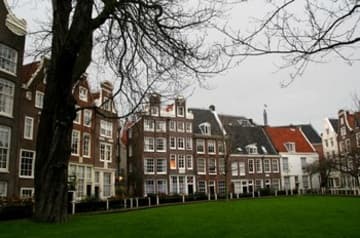
The Begijnhof consists of tiny houses grouped around a well-kept courtyard.
/ Netherlands / Begijnhof
Sacred site
Dating from the early 14th century, this picturesque enclosed courtyard contains a Reformed Church and hidden Catholic chapel. It provides a serene oasis in the center of the city.
The Begijnhof (Beguine Court) is an enclosed courtyard in Amsterdam dating from the early 14th century. It includes several interesting religious buildings and provides an serene oasis just a block from the bustling Spui square.
The Begijnhof was built in the 14th century as a residence for the Begijntes (Beguines), a Catholic order of unmarried or widowed women who wished to live a pious life of service without becoming nuns. The Beguines received free lodging in return for caring for the sick and the educating the poor of Amsterdam.
One resident, Cornelia Arens, so loved the Begijnhof that she humbly asked to be buried in the gutter in 1654. She lies under the slab of red granite on the walkway on the left side of De Engelse Kerk. The last Beguine here died in the 1970s.
As part of the "Alteration" of 1578, the main church in the courtyard was confiscated from the Catholic Begijns for Protestant use. It was given to the Pilgrim Fathers during their brief stay in Amsterdam in 1607.
The Beguines went without a church for a century, but in 1671 began construction on their own Catholic chapel in the Begijnhof. The "secret" chapel was actually authorized by the Protestant authorities, but its exterior had to be hidden from public view.
As part of the "Alteration" of 1578, the main church in the courtyard was confiscated from the Catholic Begijns for Protestant use.
It was given to the Pilgrim Fathers during their brief stay in Amsterdam in 1607.
The Begijnhof consists of tiny houses grouped around a well-kept courtyard. No. 34 is the oldest house in Amsterdam, dating from 1465, and one of only two remaining wooden houses in the city center. The rest were destroyed by a series of fires, which led to the passing of a law against all-timber buildings.
On the building's left side are biblical plaques, with scripture quotes and illustrations. Furniture from the Begijnhof can be seen in house No. 38.
The small Engelse Kerk (English Church), across the courtyard at No. 48, dates from 1400 and belonged to the Beguines until it was confiscated in 1578. Despite its name (which may simply refer to the language spoken there), it is a Scottish Presbyterian church.
The Mirakel-Kapel or Begijnhof-Kapel, close to the English Church at No. 29, was built by Catholic architect Philips Vingboons in 1671. It once contained the communion wafer from the Miracle of Amsterdam (1345), whose story is told in the stained-glass windows.
Highlights from Sacred Destinations
Highlights from Sacred Destinations
Advertisement
Advertisement
Advertisement
Where on earth