Highlights from Sacred Destinations
Explore the site
He Hua Temple is the largest Buddhist temple in Europe built in the traditional Chinese style, yet it seems small and tranquil.
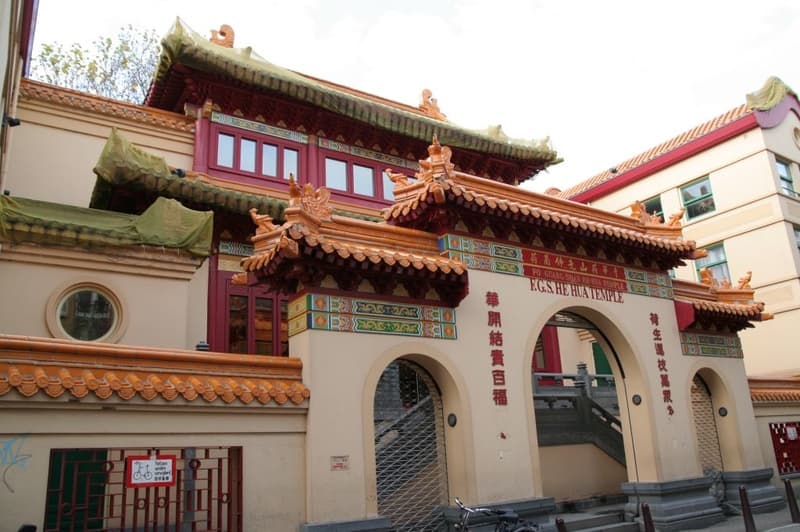
/ Netherlands / Chinese Buddhist Temple
Sacred site
Amsterdam 's China Town is home to a Chinese Buddhist temple called Fo Guang Shan He Hua (or the Zeedijk Tempel , after its location) He Hua means "lotus flower," a prominent Buddhist symbol of enlightenment because it grows from the mud yet its petals bloom pristinely above it all.
Amsterdam's China Town is home to a Chinese Buddhist temple called Fo Guang Shan He Hua (or the Zeedijk Tempel, after its location)
He Hua means "lotus flower," a prominent Buddhist symbol of enlightenment because it grows from the mud yet its petals bloom pristinely above it all. Fo Guang Shan is the Buddhist sect to which the temple belongs.
The temple cost 9 million guilders (4.1 million euros) to build, 6 million of which was donated by the Fo Guang Shan organization and the remainder by businessmen and other private donors. It was completed in 2000 and dedicated in person by Queen Beatrix of the Netherlands.
He Hua Temple is the largest Buddhist temple in Europe built in the traditional Chinese style, yet it seems small and tranquil. The entrance gate is in the traditional style: a large central opening usually reserved for monks and nuns and two side entrances for laymen. The three gates symbolize the three jewels (or three refuges) of Buddhism: the Buddha, the dharma (teaching) and the sangha (monastic community).
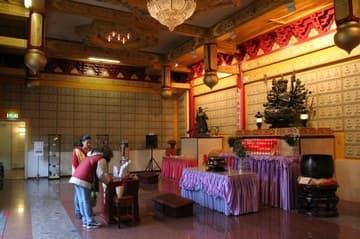
Inside, the temple consists of an open-plan room with a central shrine to Avalokitesvara, a bodhisattva of compassion who has vowed to help others to enlightenment. Avalokitesvara is a female deity known as Kwan Yin in the Chinese tradition. She has multiple hands that make symbolic gestures and hold symbolic objects. Kwan Yin is flanked by two statues of Wei Tuo en Qie-Lan, the legendary protectors of the Dharma and the temple. Visitors can purchase and offer incense or piece of fruit at the shrine.
Another shrine is dedicated to the historical Buddha, Shakyamuni. Nearby are two pagodas with illuminated niches containing hundreds of tiny Buddha statues. The repetition of the images symbolize the universal Buddha nature that is present everywhere.
The walls are covered in plaques with reliefs of Kwan Yin and inscriptions naming the donors who funded the construction of the temple. On the right side wall is a small museum of Buddha images and other artifacts.
In addition to this main hall, a level below has a Jade Buddha Shrine and the complex also includes a meditation hall, a hall for honoring ancestors, a meeting room, classrooms, a library, a dining room and bedrooms.
Highlights from Sacred Destinations
Highlights from Sacred Destinations
Advertisement
Advertisement
Advertisement
Where on earth