Highlights from Sacred Destinations
Explore the site
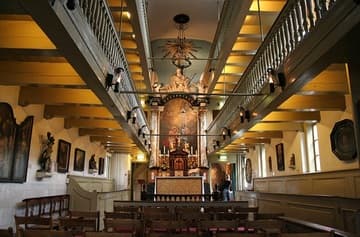
The church occupies the entire upper floor of the canal house and is accessed by very steep, creaky wooden stairs.
/ Netherlands / Museum Amstelkring
Sacred site · 1661-63
This Catholic church in a canal house of the Red Light District is the only surviving schuilkerken (clandestine church) that dates from the Reformation, when open Catholic worship was outlawed.
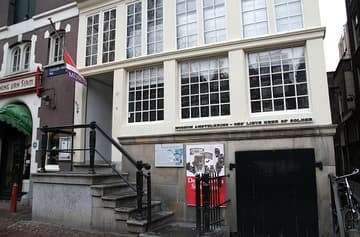
The Red Light District in Amsterdam might seem an unlikely location for a notable religious site, but Ons' Lieve Heer op Solder ("Our Lord in the Attic"), also known as the Museum Amstelkring, is one of the most interesting churches in the city. Hidden inside a 17th-century canal house, the clandestine Catholic church is a beautiful and fascinating place.
Catholic Mass was outlawed in Amsterdam shortly after the "Alteration" of 1578, which transferred the city into Protestant hands. However, Protestant authorities tended to be tolerant of private Catholic worship as long as it was kept hidden from public view.
In 1661, a wealthy Catholic merchant named Jan Hartman bought a stately canal house and two houses behind it. A devout man whose son was studying for the priesthood, Hartman included a fine Catholic chapel in his new property. The rest of the houses were used as living space for his family, reception of guests, and storage.
The hidden church occupied the entire top floor of the canal house and the two houses behind it. Lavishly appointed, it would serve as the parish church for Catholics living in the city center for 200 years.
The church was then referred to as "the Hart," after the statue of a stag that hung outside, presumably inspired by the host's name. It was dedicated to St. Nicholas, taking over the patronage stripped from the Oude Kerk at the Alteration.
The house and church underwent some renovations in 1739 after the priest Ludovicus Reiniers purchased the property. He added another stairway to the church, rebuilt the facade, and removed the stag outside. The church was now referred to as "Our Lord in the Attic."
In 1887, the large St. Niklaaskerk near the train station was dedicated, replacing Our Lord in the Attic as the local parish church. A group of Catholics pooled their funds to purchase the hidden church, saving it from demolition. A year later, on April 28, 1888, it was opened to the public on weekdays as a museum, making it the oldest musuem in Amsterdam after the Rijksmuseum.
Today, the Church of Our Lord in the Attic is still a museum, but it also hosts Catholic worship services and weddings.
Lavishly appointed, it would serve as the parish church for Catholics living in the city center for 200 years.
Catholic Mass was outlawed in Amsterdam shortly after the "Alteration" of 1578, which transferred the city into Protestant hands.
The church occupies the entire upper floor of the canal house and is accessed by very steep, creaky wooden stairs. The long narrow nave is lined with two wooden galleries and contains seating for about 150 worshippers, fine paintings and sculptures.
The church is beautifully decorated in the Dutch classicist style, with marble columns, gilded capitals, and a marble alta with a painting of the Baptism of Christ (1716) by Jacob de Wit and stucco sculptures of God the Father and the Holy Spirit.
A bonus to this fascinating church is the rest of the private house, which is open to visitors as part of the Museum Amstelkring. It is beautifully preserved in its original 17th-century condition.
Renovated by Jan Hartman between 1661 and 1663, the house includes a variety of interesting rooms, such as the kitchen decorated with painted porcelain tiles, a chaplain bedroom with period furnishings, a storeroom on the ground floor, and a magnificent drawing room on the first floor.
The star attraction of the house, the drawing room (sael) was designed by the wealthy merchant to receive (and impress) guests. Its stately furnishings make it one of the most impressive 17th-century rooms left in Amsterdam. A copy of it has even been constructed in Japan. The main artwork is a 17th-century Dutch copy of a painting by the Venetian Andrea Schiavone (1510-63) depicting the Presentation of Jesus in the Temple.
In addition to period furnishings, the house contains an impressive collection of canvases by Thomas de Keyser, Jan Wynants, and Abraham de Vries as well as church silver and sculptures.
Highlights from Sacred Destinations
Highlights from Sacred Destinations
Advertisement
Advertisement
Advertisement
Where on earth