Highlights from Sacred Destinations
Explore the site
Several Leiden notables are buried in Pieterskerk, including the Pilgrim pastor John Robinson , the theologian Jacobus Arminius and the painter Jan Steen.
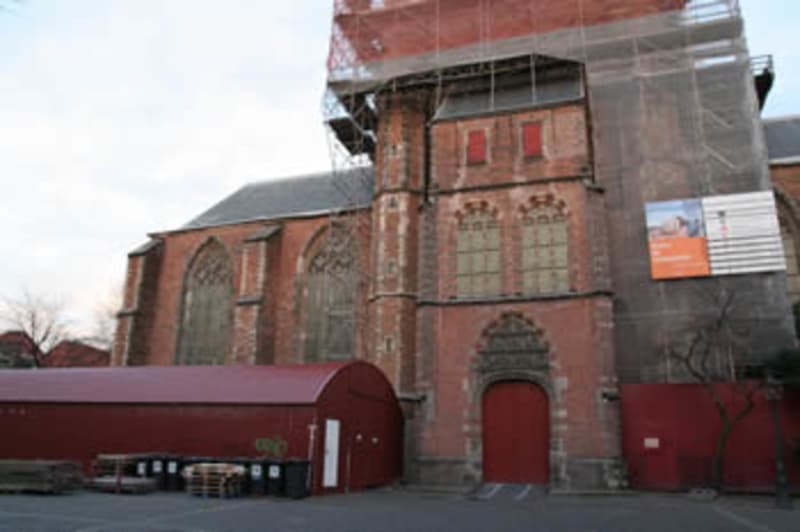
/ Netherlands / Pieterskerk
St. Peter · 1390-1565
The Pieterskerk (St. Peter's Church) is a Gothic church built between 1390 and 1565 and now deconsecrated. Several Leiden notables are buried here, including Pilgrim pastor John Robinson, theologian Jacobus Arminius and painter Jan Steen.
The Pieterskerk (St. Peter's Church) in Leiden is a Gothic church built between 1390 and 1565 and now deconsecrated to serve various non-religious functions.
The history of the Pieterskerk begins around 1100, when the Counts of Holland had a chapel built on the site where the nave stands today. It was renovated in 1121.
In 1268, the counts' private chapel became a parish church to serve the growing population of Leiden. It was replaced with a larger church in 1300, and around 1350 it was given a tall tower (over 110m high), which became known as the "King of the Sea" for its use as a reference point by sailors.
Construction of the present Pieterskerk began in 1390 and continued for some 175 years. The primary architect was Rutger van Kampen, a.k.a. Rutger van Keulen. After his death, Aernt van den Dom, who also worked on Utrecht Cathedral, took over.
The choir was completed and consecrated in 1412. Construction on the nave and side aisles followed shortly thereafter, and in 1450 additional side aisles were added. The church was mostly completed by 1500, but further work was required after the west tower collapsed in 1512. The west tower was replaced with a free-standing belfry, the west end was renovated, and the transept was raised to the height of the nave (it previously matched the height of the side aisles). Construction was finally completed in 1565.
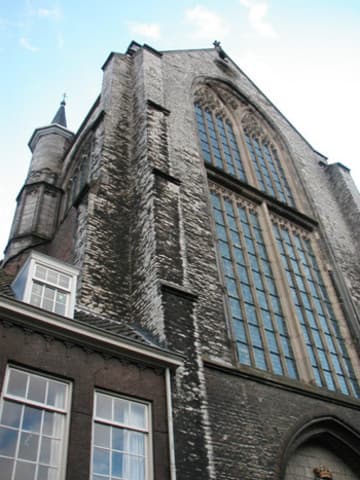
The Reformation came to Leiden in 1572, after which the church was used by the Dutch Reformed Church. The medieval stained glass windows fell into disrepair, and a gunpowder explosion on a nearby ship in 1802 destroyed them completely. Houses were built against the side of the church in the 17th century, some of which still stand next to the choir.
Construction of the present Pieterskerk began in 1390 and continued for some 175 years.
The history of the Pieterskerk begins around 1100 , when the Counts of Holland had a chapel built on the site where the nave stands today.
Several Leiden notables are buried in Pieterskerk, including the Pilgrim pastor John Robinson, the theologian Jacobus Arminius and the painter Jan Steen. The memorial to John Robinson is in the octagonal baptistry in the far corner opposite the transept entrance.
The Pieterskerkhof (Churchyard) also contains several sites of interest. Jacobus Arminiuslived in a house facing the church, and the white house on the corner of the Kloksteeg was where the family of Pilgrim Thomas Rogers lived briefly while he went to America in 1620.
The house of Thomas Brewer, who provided financial support for William Brewster's printing activities, is the to the right of the almshouse on the opposite side of the Kloksteeg. The minister of the English Reformed Church, Hugh Goodyear, lived here for a while.
Highlights from Sacred Destinations
Highlights from Sacred Destinations
Advertisement
Advertisement
Advertisement
Where on earth