/ Norway / Urnes Stave Church
Sacred site · 1130
Urnes Stave Church
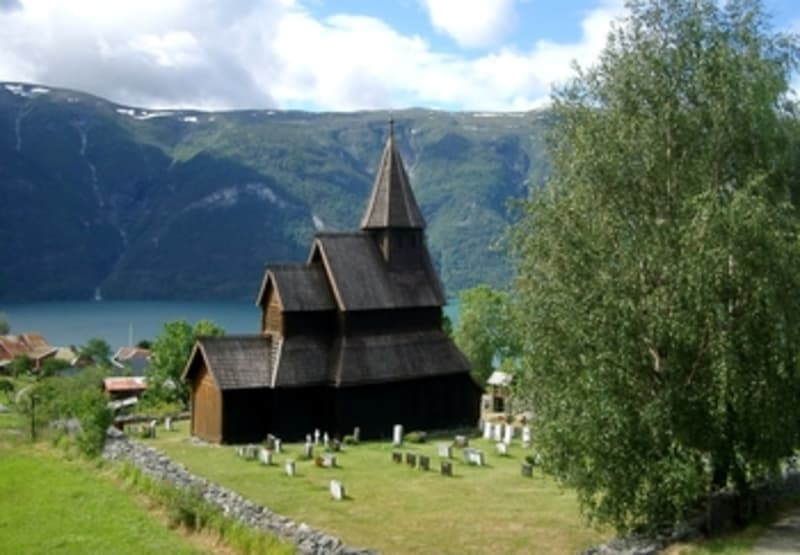
The oldest and most richly decorated of Norway's 29 stave churches, Urnes also boasts a picturesque fjordside location.
Dating from 1130, Urnes Stave Church in Western Norway is the oldest of its kind in the country. It has some of the richest carvings of Norway's stave churches and is the only one to be recognized by UNESCO as a World Heritage Site.
People have lived on this beautiful and strategic spot along the Lusterfjord since prehistoric times, as evidenced by three burial mounds, several cairns and a monumental stone discovered around the church.
Christianity arrived in Norway in the 10th and 11th centuries, and it was during this early period that the first church was built on the site (c.1000-50). Christian graves have been found beneath the ruins of this first church. Remains of the next church, built c.1050-70, have also been found and its elaborate north portal is still preserved.
The present church at Urnes dates from about 1130. Since it is made of wood, dendochronology could be used to precisely determine when the trees were cut (1129-31) and therefore when the church was built.
At the time, a large farm at Urnes belonged to a chieftain and his family. They owned several such farms in the area and were powerful local rulers. The artistic decoration of Urnes stave church, although unique in style, shows external influences that may indicate craftsmen were hired from as far away as Trondheim.
Numerous changes were made to the church over the centuries, including a redecoration of the interior in the 17th century that mostly survives today. Some restorations were made around 1900 to return the archtitecture to its original form.
Urnes Stave Church became the property of the Fortidsminneforeningen (Society for the Preservation of Norwegian Ancient Monuments) in 1880. The society uses a design from one of the church's capitals as its logo.
Urnes Stave Church occupies a peaceful, beautiful location in the countryside next to a fjord and tree-covered mountains. It can only be reached by a 10-minute uphill walk from the little hamlet of Ornes.
The church's architecture, an example of the Kaupanger group of "Type B" stave churches, is elegantly simple. It is supported by a framework of upright posts ("stave") which do not rot because they are kept out of contact with the earth.
There are not many windows - the main light comes from a small window in the west facade - and the interior is dimly lit. More windows were added along the walls after the Reformation, but these were removed in restorations in 1900.
Closer inspection reveals an extraordinary richness of medieval carvings, some of which even predate the church. The oldest can be seen in two door panels from around 1070 incorporated into the north wall. In a unique style relying heavily on the heritage of Viking pagan art, the carvings depict stylized mythical creatures entwined among foliage.
The interior is an intimate space with mostly 17th-century furnishings and a number of medieval carvings, including a portrait of a pilgrim on a capital. The cushion capitals are an adaptation of those found in Romanesque stone churches elsewhere in Europe. The bishop's throne is also medieval. And suspended above the nave is a Crucifixion group dating from the 12th century - the oldest Christian figures in Norway.
The round arches supporting the interior were made using the naturally curved parts of tree, where the trunk meets the branches. The ceiling dates from the 17th century and is different from the original design, which was shaped like an upside-down boat.
A small museum in the nearby ticket office includes photos of the interior carvings, which are hard to see in the dim light.
Advertisement
Advertisement
Advertisement
Gallery
Location
Where on earth