Highlights from Sacred Destinations
Explore the site
The north and west entrances from the parvise are decorated with whitestone portals of the 16th century.
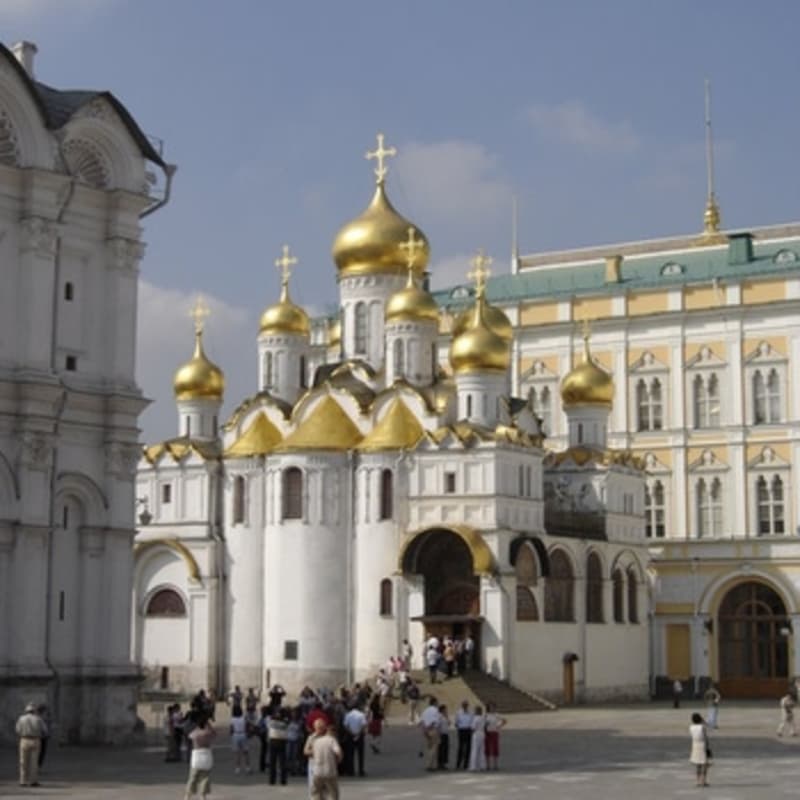
/ Russia / Cathedral of the Annunciation
Sacred site · 1484-89
Blagoveschensky Sobor was built 1484-1489 by Russian architects and was the personal church of the royal family until the 20th century.
The Cathedral of the Annunciation (Blagoveschensky sobor) is a cathedral in Moscow's Kremlin. Originally the royal chapel of the Muscovite tsars, the Annunciation Cathedral's abbot was a personal confessor of the royal family until the early 20th century.
The Cathedral of the Annunciation was built on the Sobornaya Square (Cathedral Square) by architects from Pskov in 1484-1489. It was erected on the spot of an older cathedral, a triangular brick church in the early Moscow style.
Initially, the Cathedral of the Annunciation had three cupolas (two of them built around 1572). It was surrounded by parvises from three sides. In 1562-1564, four single-cupola side chapels were built over the arched parvises.
Ivan the Terrible had to enter the church by the southeast porch entrance, built especially for him. This is because he was married three times too many (for a total of six wives) and was therefore, under the rules of the Orthodox Church, not allowed to enter the church through its main entrance.
The Cathedral of the Annunciation was built on the Sobornaya Square (Cathedral Square) by architects from Pskov in 1484-1489 .
In 1562-1564, four single-cupola side chapels were built over the arched parvises.
The north and west entrances from the parvise are decorated with whitestone portals of the 16th century. The fretwork is clearly influenced by the Italian Renaissance. The copper doors of the north and west portals are decorated with golden foil.
The interior walls are covered in brilliant frescoes painted by the Russian artist Feodosy (1508). The floor is covered in tiles of agate jasper, said to be a gift from the Shah of Persia in the 16th century.
But the highlight of the Cathedral of the Annunciation is the striking iconostasis. The icons of the second and third tiers were painted by some of Russia's greatest masters: Andrei Rublev, Theophanes the Greek, and Prokhor of Gorodets.
Highlights from Sacred Destinations
Highlights from Sacred Destinations
Advertisement
Advertisement
Advertisement
Where on earth