Highlights from Sacred Destinations
Explore the site
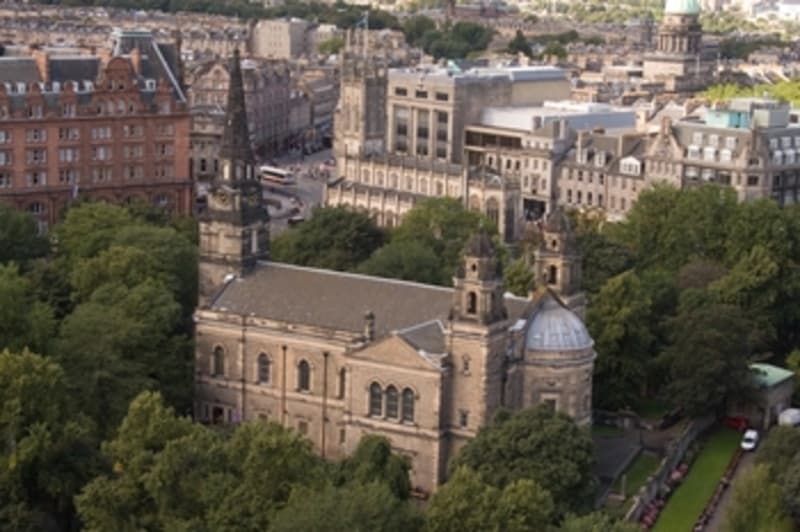
Nestled in the trees in the shadow of Edinburgh Castle, St.
/ Scotland / St Cuthbert's Church
St. Cuthbert
This historic church in Edinburgh has a friendly congregation that emphasizes Celtic spirituality.
St. Cuthbert's Church in Edinburgh is a historic church with a friendly congregation that emphasizes Celtic spirituality.
Tradition has it that St. Cuthbert, the famed monk-bishop of Lindisfarne, stopped by the shores of the Nor' Loch (a lake now replaced with Princes Street Gardens) just below Edinburgh Castle and built a little hut there.
This is the site of St. Cuthbert's Parish Church, whose current incarnation dates from the 19th century but is built over at least six earlier places of worship.
The first record of St. Cuthbert's Church in Edinburgh is in 1127, when King David I gave all the land below the Castle to St Cuthbert's. Little is known of the church's history from the 12th to the 16th century, aside from occasional references in Vatican documents.
In 1990, the church was expanded and modernized, with the addition of several new rooms and better access for the disabled.
Cuthbert's Church in Edinburgh is in 1127, when King David I gave all the land below the Castle to St Cuthbert's.
In 1990, the church was expanded and modernized, with the addition of several new rooms and better access for the disabled.
Nestled in the trees in the shadow of Edinburgh Castle, St. Cuthbert's Church is a large and imposing structure. Its cupolas and steeples can be seen from various spots around the city, yet the church feels peacefully removed from the bustle of the nearby Princes Street.
The church has a basilica-like layout, with an apse and rounded vault. Inside, the exterior uses colored stone for a rich and warm effect. The design of the Communion Table (1894), the marble and alabaster Pulpit (1897) and the ceiling paintings (by Hope and Moira), give an overall Byzantine feel to the interior.
Much of the other decoration is inspired by the Italian Renaissance (popular at the time of the chruch's constuction), complete with a da Vinci-inspired Last Supper frieze curving around the apse (1906). The minister of the time, Rev Dr James MacGregor, had to defend the beauty of the apse against some who thought it too richly adorned.
The baptismal font is based on that in Siena Cathedral and is topped with a sculpture of a mother and child (1912) based on Michelangelo's Bruges Madonna. This font sculpture caused considerable controversy because it appeared to depict the (Catholic) Virgin and Child. The "font sculpture issue" was discussed at length by the General Assembly of the Church of Scotland and in the press.
Above the communion table is a mural of Christ in Glory by Robert Hope. The Four Evangelists by Sir Gerald Moira are on the ceiling over the chancel. St. Cuthbert's stained glass windows were installed between 1893 and 1912 and depict Old Testament and Gospel scenes.
The new Lindisfarne Room, a bright space used for conferences, is decorated with a huge mural of St. Cuthbert on Lindisfarne by Gerald Moira.
The poet Thomas de Quincey (1785-1859), the artist Alexander Nasmyth (1758-1840) and George Kemp (1795-1844), the designer of the Scott Monument, lie in St. Cuthbert's graveyard (kirkyard).
Highlights from Sacred Destinations
Highlights from Sacred Destinations
Advertisement
Advertisement
Advertisement
Where on earth