Highlights from Sacred Destinations
Explore the site
The west facade looks quite lopsided - the cathedral remains unfinished and the south tower was never built.
/ Spain / Avila Cathedral
Holy Savior · 12th-14th C
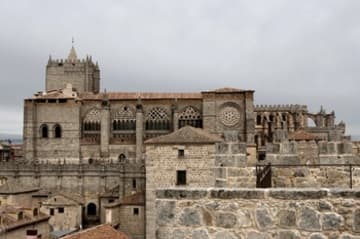
Ávila's fortress-like cathedral was begun in the Romanesque style in the 12th century and later continued in the Gothic style, resulting in intriguing combination of styles and materials.
The 12th-century Ávila Cathedral is a strong, fortress-like cathedral adjoining the famous medieval walls of Ávila.
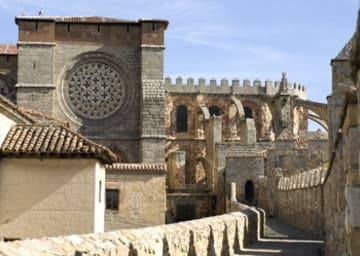
Construction on Ávila Cathedral began in 1095shortly after the Reconquest. The earliest parts were in the Romanesque style and built like a fortress - in fact, the apse ("Cimorro") is built right into the city walls.
Dedicated to San Salvador, Ávila Cathedral is truly a cathedral-castle, with battlements and sentry walks incorporated into the structure. It's not just for looks, either - in the 12th century, Bishop Sancho protected the young Alfonso IX until he became king.
Most of the cathedral that can be seen today was built between the 12th and 14th centuries. During this time, the trend moved from Romanesque to Gothic styles, and the transition can be clearly seen in the interior.
The west facade looks quite lopsided - the cathedral remains unfinished and the south tower was never built.
Inside, visitors can see the change from Romanesque to Gothic in action - the earlier Romanesque parts are made of a red-and-white stone, while the Gothic parts were built with pure white stone. The Gothic half of the cathedral seems more spacious than the Romanesque, yet the proportions are exactly the same.
The coro (choir) and two chapels in the left aisle date from the Renaissance. The elegantly carved stalls of the choir are the work of a Dutch sculptor, Cornelius. Here also is the marble tomb of a 15th-century bishop dubbed El Tostado ("The Toasted," for the brownish tone of the tomb).
Other highlights of the interior include the 13th-century sacristy, with a star-shaped cupola and gold inlay, and the treasury, with a huge silver monstrance and medieval religious icons.
Highlights from Sacred Destinations
Highlights from Sacred Destinations
Advertisement
Advertisement
Advertisement
Where on earth