Highlights from Sacred Destinations
Explore the site
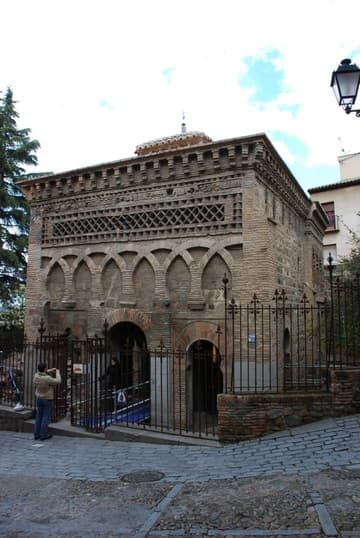
The square part of the building is original from the 10th-century mosque.
/ Spain / Mezquita del Cristo de la Luz
Christ of the Light · 999
One of the oldest Moorish monuments in Spain, this tiny 10th-century mosque was built over a Visigothic chapel then converted into a church by King Alfonso.
The Mezquita del Cristo de la Luz (Mosque of Christ of the Light) is a fascinating little former mosque in a park above the northern ramparts of Toledo, Spain. Dating from the late 10th century, it is the only surviving mosque out of the ten that once stood throughout Toledo.
Built over the site of a Visigothic church, the Mezquita is one of the oldest Moorish monuments in Spain. An Arabic inscription on the facade tells us that it was constructed by one Musa Ibn Ali in 999 AD (390 AH).
Despite its dimunitive size, this mosque was very important in the Islamic era, due both to its location in a wealthy quarter and its proximity to the Alcazaba, an elevated fortress that stood on the site of the Alcazar.
The chapel derives its name from a legend: when King Alfonso VI rode into Toledo in triumph in 1085, his horse fell to its knees out front (a white stone marks the spot). It was then discovered that a candle had burned continuously behind the masonry throughout three and a half centuries of Muslim rule, illuminating a hidden crucifix.
The history is a little more obscure. After the conquest of Toledo in 1085, the building was still known as Bab-al-Mardum. It wasn't until 1186 that the mosque was converted to a chapel, when it was given by King Alfonso VIII to the Knights of St. John and named Ermita de la Santa Cruz (Chapel of the Holy Cross).
The first mass of the Reconquest was said here, and a transept was later added, along with a Mudejar apse decorated with blind arches. The church portion of the structure is thought to be the first product of the Mudejar style.
An Arabic inscription on the facade tells us that it was constructed by one Musa Ibn Ali in 999 AD (390 AH).
An Arabic inscription on the facade tells us that it was constructed by one Musa Ibn Ali in 999 AD (390 AH).
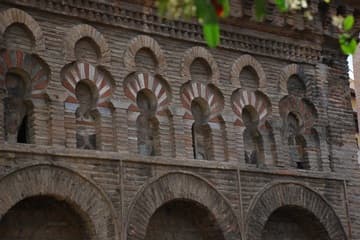
The square part of the building is original from the 10th-century mosque. At the top of the facade is an Arabic inscription in brick that reads:
Below this is open latticework of bricks, followed by a blind arcade of entwined horseshoe arches, and at the bottom are three entrance doors. Three more doors are on the northwest facade, which provide access to the courtyard. Along the top are sets of red-and-white striped horseshoe arches, reminding one of the much larger versions in the Mezquita of Cordoba.
Inside, the mosque is 7.74 m by 8.60 m in size. Pillars and horseshoe arches divide the space into three aisles crossed by another three, forming nine small compartments. These are topped with square vaults, each of which has a unique and attractive geometrical design. Some of the columns rest on Visigothic capitals.
The apse at the back was added after its conversion to a church in the 12th century and is a fine example of Mudejar architecture (and quite possibly the earliest anywhere).
It was decorated with murals of Christ and other figures, some of which still survive. Especially notable is a faded Christ Pantocrator on a blue background in the far east end.
The crucifix found in the Mezquita is now housed in Toledo's Santa Cruz Museum.
Next to the Mezquita is a small peaceful garden centered on a little fountain. Walk a bit beyond the garden for fine views over the north edge of the city walls and the large Puerta del Sol city gate.
Highlights from Sacred Destinations
Highlights from Sacred Destinations
Advertisement
Advertisement
Advertisement
Where on earth