Highlights from Sacred Destinations
Explore the site
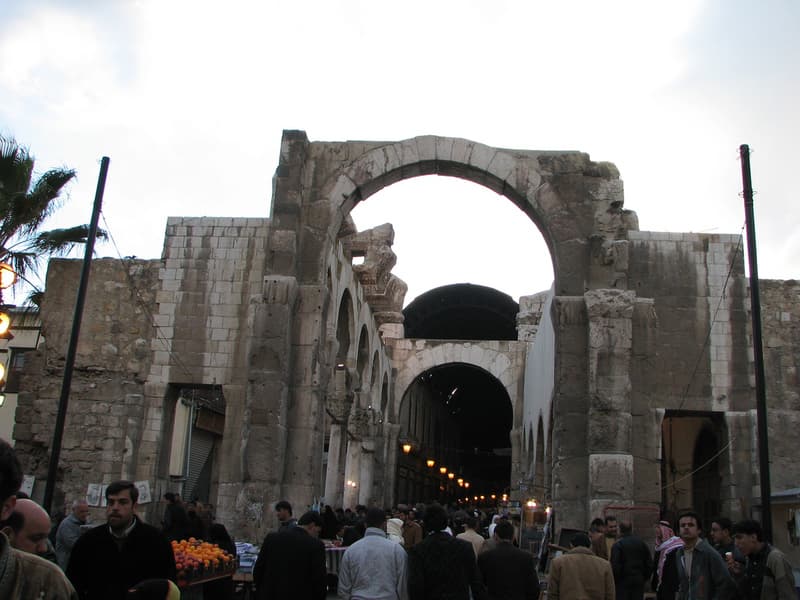
The east end of Straight Street is at Bab Sharqi , the Roman gate of the Sun.
/ Syria / Straight Street
Sacred site
his historic street is as straight today as when it was walked by St. Paul. Today it contains many markets, the House of Ananias, several Roman arches and mosques.
Straight Street (or in Latin, Via Recta), is the Roman street that runs from east to west in the old city of Damascus. It was visited by St. Paul as recorded in the book of Acts and contains several interesting sights from the Roman, Christian and Islamic periods.
Under the Greeks, the old city of Damascus was designed after the grid pattern designed by Hippodamus. Under Roman rule, the Via Recta was widened and became a colonnaded thoroughfare (cardo). These columns can still be seen today.
The east end of Straight Street is at Bab Sharqi, the Roman gate of the Sun. Like other monumental gates, it has a large central arch for horse-drawn vehicles and two smaller arches on either side for pedestrians. There is a minaret above the northern arch, which was built at the time of Nuri ed-Din, in the 13th century.
Entering the city from the east through the Bab Sharqi, one can still see the remains of a double colonnade that used to line the entire length of the street. In Roman times, Straight Street was 26 meters wide and 1,570 meters long, lined on both sides with covered porticos containing shops. The present road follows the same line, starting at Bab Sharqi in the East, crossing the whole width of the ancient city of Damascus, and coming out at the end of Suq Madhat Pasha, 20 meters to the North of Bab Jabyeh on the western side. The present road is narrower than the ancient one, and about 4 meters above its original level.
Almost 700 meters to the west of Bab Sharqi is a Roman monumental arch that was excavated and rebuilt in 1947 by the Syrian Department of Antiquities. It is here that the intersection of Straight Street and the north-south Cardo Maximus has been located. On the right-hand side in ancient times stood a Byzantine church dedicated to the Virgin Mary and called Mariamyeh. Today, on the same site, stands a church which serves as the Seat of the Greek-Orthodox Patriarchate.
The eastern section of the street from the Bab Sharqi gate to the monumental arch is called Sharee al Mustaqueem, which is the Arabic word for 'straight', but it is also known as the Suq et-Tawil, which means 'the large market'. After the arch and all the way to the western end, the street is called Suq Madhat Pasha, and is lined with shops selling textiles, cotton, domestic articles, spices, imported objects and other interesting items. It forms a part of the large commercial complex of Suq el Hamidyeh.
About 450 metres from the western entrance of Madhat Pasha Street, in a stretch covered with a large metal dome, is a small mosque with a balcony in the form of a pulpit that serves as a minaret, called Jakmak or Sheikh Nabhan Mosque. It is here that the Christian tradition locates the house of Judas, the place where Saul remained for three days without eating or drinking and was baptized at the hands of Ananias (Acts 9:9). The Christians of Damascus say the mosque was built over the ruins of an ancient church that commemorated the episode narrated in the Acts of Apostles. Today, the nearby Chapel of Ananias commemorates the event.
At the west end of Straight Street is the Arab Gate of the Water Trough, Bab al-Jabiye. This is where the Roman Temple of Jupiter once stood. The Mosque of Hisham (built in 1427), with fine stalactite design, is a bit further on. It is believed that the theaterbuilt by Herod the Great in the 1st century BC was in this area.
Also nearby is St. Paul's Chapel, said to be where St. Paul fled by being dropped in a basket through a window in the wall.
Highlights from Sacred Destinations
Highlights from Sacred Destinations
Advertisement
Advertisement
Advertisement
Where on earth