Highlights from Sacred Destinations
Explore the site
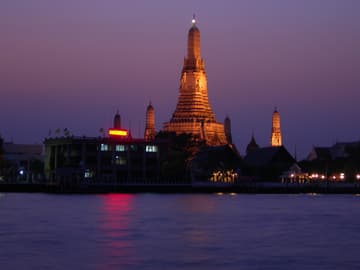
Despite its name (from Aruna, the Hindu god of the dawn), the best views of Wat Arun come at sunset - there are several restaurants and coffee shops across the river that make fine viewpoints.
/ Thailand / Wat Arun
Sacred site · 18th C
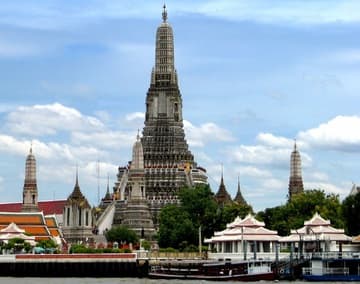
This beautiful Buddhist temple is a major landmark on the west bank of the Chao Phraya River. The central chedi, covered in shells and porcelain, represents mythical Mt. Meru.
Wat Arun("Temple of the Dawn") in Bangkok is a Khmer-style Buddhist temple and major landmark on the west bank of the Chao Phraya River.
Wat Arun was built in the days of Thailand's ancient capital of Ayutthaya, and was originally known as Wat Makok ("Olive Temple").
In the ensuring era when Thonburi was capital, King Taksin changed the name to Wat Chaeng. The temple briefly hosted the revered Emerald Buddha after it was recaptured from Laos, but it was moved to Wat Phra Kaew in 1784.
King Rama II enlarged the central prang and changed the temple's name to Wat Arunratchatharam. The work was finished by King Rama III, and King Rama IV gave the temple its current full name of Wat Arunratchawararam.
Despite its name (from Aruna, the Hindu god of the dawn), the best views of Wat Arun come at sunset - there are several restaurants and coffee shops across the river that make fine viewpoints.
The outstanding feature of Wat Arun is its central prang (a prang is a Khmer-style pagoda), which is about 80 meters tall and symbolizes the legendary Mount Meru, center of the universe. It is possible to climb the prang, using some very steep exterior steps, to two terraces providing fine views.
The corners are surrounded by four smaller satellite prangs, which are dedicated to the wind god Phra Phai. The prangs are decorated by seashells and bits of porcelain which were used as ballast by boats coming to Bangkok from China.
Around the base of the prang are various sculptures of ancient Chinese soldiers and animals. Over the second terrace are four statues of the Hindu god Indra riding on Erawan.
At the riverside are six pavilions (sala) in Chinese style, made of green granite and contain landing bridges.
Next to the prangs is the Ordination Hall with the Niramitr Buddha image said to have been designed by King Rama II. The front entrance of the Ordination Hall has a roof with a central spire, decorated in coloured ceramic and stuccowork sheated in colored china.
There are two temple guardian figures in front. Characters from the Hindu epic Ramayana, the white figure is named Sahassateja and the green one is known as Tasakanth.
Highlights from Sacred Destinations
Highlights from Sacred Destinations
Advertisement
Advertisement
Advertisement
Where on earth