Highlights from Sacred Destinations
Explore the site
The first floor of the Assembly Hall holds a striking statue of Dalai Lama XIII, magnificently lit by filtered sunshine and pungent yak butter lamps.
/ China / Drepung Monastery
Sacred site · 1416
Founded in 1416, this monastery on the outskirts of Lhasa was once Tibet's largest and most influential, with over 10,000 monks. It remains active today.
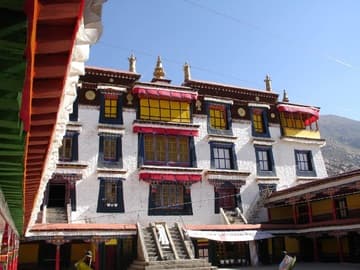
Founded in 1416, Drepung Monastery (Tibetan: Drepung Gompa; Chinese: Zhébàng Sì) on the outskirts of Lhasa was once Tibet's largest and most influential monastery, with over 10,000 monks. Today, Drepung houses about 700 monks and attracts pilgrims and visitors from around the world.
Drepung is especially known as the site of the annual Shoton Festival, with its dramatic unfurling of a giant thangka painting on the hillside.
Drepung Monastery was founded in 1416by Tsongkapa's disciple Jamyang Choeje. It was the home of the Dalai Lamas before the Potala Palace was built in the 17th century. Resembling a heap of white rice from a distance, it was dubbed "Monastery of the Collecting-Rice" (Drepung Gompa) in Tibetan.
The monastery fared comparatively well in the Cultural Revolution (1966-77), but its involvement in pro-independence demonstrations of 1987 has led to close surveillance by the Chinese government.
On September 27, 1987, about 20 Drepung monks unfurled banners and the Tibetan flag and marched around the Barkhor in Lhasa, before being arrested in front of the Tibetan Autonomous Region Government Headquarters. Today, a Public Security Bureau compound sits below the monastery and "cadre monks" keep a close eye on day-to-day activities.
Drepung lost a major source of income with the death of the charismatic teacher Gen Lamrim in 1997, whose lectures drew devotees from all over the Tibetan world. The monastery therefore gratefully accepts donations from pilgrims and visitors, which can be made in the kitchen.
Drepung Monastery was founded in 1416 by Tsongkapa's disciple Jamyang Choeje.
The monastery fared comparatively well in the Cultural Revolution (1966-77), but its involvement in pro-independence demonstrations of 1987 has led to close surveillance by the Chinese government.
The first floor of the Assembly Hall holds a striking statue of Dalai Lama XIII, magnificently lit by filtered sunshine and pungent yak butter lamps. Readings of the scriptures are often held here at midday, during which novices race one another to fetch tea from the kitchen for their elders.
To the left (west) of the Assembly Hall is the kitchen, where butter tea is prepared and donations are accepted.
The most revered image at Drepung is a 15m (49-ft.) tall statue of the 8-year old Maitreya Buddha (the future Buddha), designed by Tsongkapa and housed on the third floor of the main building. Visitors are offered holy water; to receive it, cup your right hand above your left, take a sip, and splash the rest on your head.
The second floor houses Buddhist scriptures and the first floor contains multiple Buddha statues and other decorations. A chapel to the north of the second floor houses a sacred mirror said to cure the facial diseases of those who gaze into it.
Several courtyards in the forest around the monastery are used by the monks for debating the sutras (Buddhist scriptures). The winners of the debates can take a test to earn the senior degree of Geshi.
Highlights from Sacred Destinations
Highlights from Sacred Destinations
Advertisement
Advertisement
Advertisement
Where on earth