Highlights from Sacred Destinations
Explore the site
John's basilica was cruciform and roofed with six massive domes.
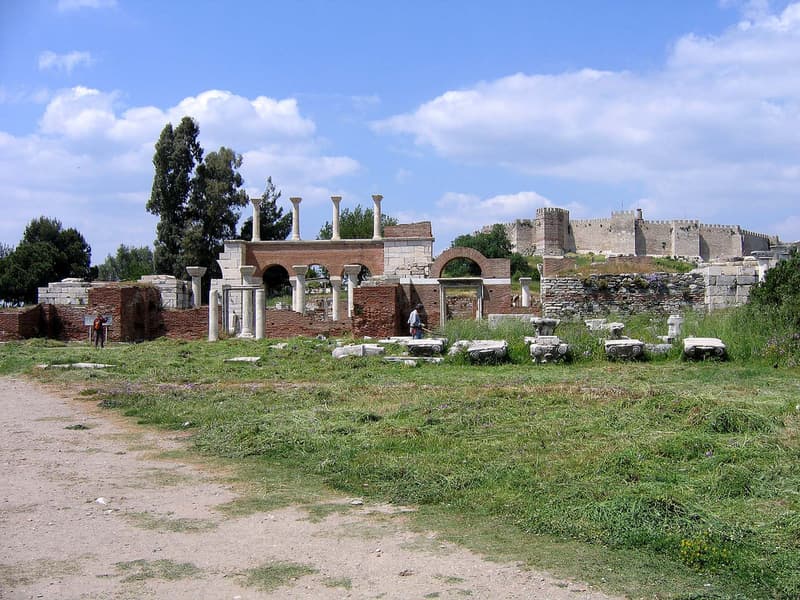
/ Turkey / Basilica of St. John
St. John the Evangelist · c. 530
The Basilica of St. John was built by Emperor Justinian in the 6th century over the traditional tomb of John the Evangelist. The site became a major pilgrimage destination in the Early Middle Ages.
The Basilica of St. John (St. Jean Aniti) was a great church in Ephesus constructed by Emperor Justinian in the 6th century. It stands over the believed burial site of St. John, who is identified as the apostle, evangelist (author of the Fourth Gospel) and prophet (author of Revelation).
The basilica is on the slopes of Ayasoluk Hill near the center of Selçuk, just below the fortress and about 3.5 km (2 miles) from Ephesus.
St. John's grave was marked by a memorial and enclosed by a church of modest proportions in the 4th century. In the 6th century, Emperor Justinian (527-65 AD) believed that a tomb dating from the 300s was John's, so he built a magnificient church on the site dedicated to the saint.
The traditional tomb of St. John, located under the main central dome, elevated the site to one of the most sacred sites in the Middle Ages and thousands made pilgrimage here.
But with the decline in importance of Ephesus and after Arab raids, the basilica fell into ruins until the Seljuk Aydinoglu clan converted it into a mosque in 1330. The building was then completely destroyed in 1402 by Tamerlane's Mongol army.
The ruined church was thereafter pillaged for building materials, but recent restoration enables visitors to understand its size and visualize its former splendor.
In the 6th century, Emperor Justinian (527-65 AD) believed that a tomb dating from the 300s was John's, so he built a magnificient church on the site dedicated to the saint.
But with the decline in importance of Ephesus and after Arab raids, the basilica fell into ruins until the Seljuk Aydinoglu clan converted it into a mosque in 1330.
St. John's basilica was cruciform and roofed with six massive domes. The capitals facing the nave (central aisle) bear the monograms of the Emperor Justinian and his wife Theodora.
The current entrance leads into the basilica through the southern transept. Originally, entry was through the oversize exterior courtyard atrium to the west of the nave, which led worshipers through the narthex and finally into the far end of the nave.
The brick foundations and marble walls have been partially reconstructed; if they were fully restored, the cathedral would be the seventh largest in the world.
More recent excavations east of the apse have revealed a baptistery and central pool, along with an attached chapel covered in frescoes depicting the saints.
Highlights from Sacred Destinations
Highlights from Sacred Destinations
Advertisement
Advertisement
Advertisement
Where on earth