Highlights from Sacred Destinations
Explore the site
Unfortunately the Grotto of St.
/ Turkey / Grotto of St. Paul
Sacred site
Although not generally accessible to the public, this cave is worth mentioning for the important frescoes and inscriptions that were found inside.
The Grotto of St. Paul (or Cave of St. Paul) is a cave in the slope of Bülbüldag hill in Ephesus that contains important Early Christian frescoes and inscriptions.
It is not known whether any of the churches in Ephesus were dedicated to St. Paul (unfortunately almost no dedications of the city"s churches are known), but the saint appears prominently in a sacred cave on the cliff slope of Bülbüldag.
The Grotto of St Paul (so named by excavators) has been a Christian sacred site since the 1st or 2nd century. Possibly associated with a legend of St Paul’s ministry in Ephesus, the grotto was decorated with frescoes and inscriptions over the course of many centuries, including a portrait of Paul in the 6th century and ending in about the 11th century.
The grotto was discovered in 1906 and excavated by the Austrian Archaeological Institute. Karl Herold, head of the restoration department, discovered the frescoes beneath the plaster on the cave walls.
Unfortunately the Grotto of St. Paul is not generally open to the public.
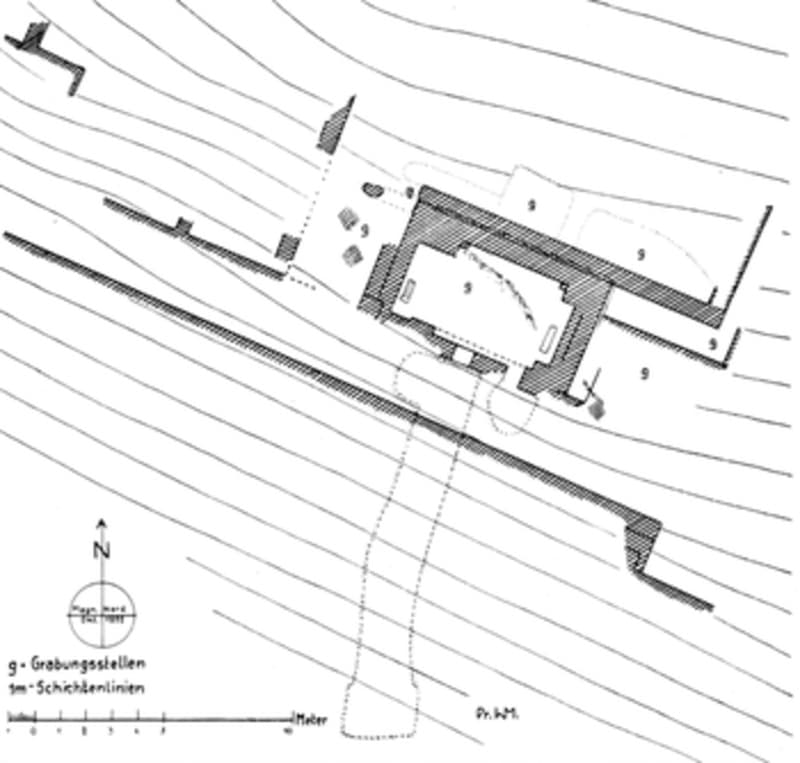
The Grotto of Saint Paul is carved into the northern slope of Bülbüldag (Nightingale Mountain), high above the Great Theater. A long corridor leads to the cave sanctuary, which is 15 meters long, 2 meters wide and 2.5 meters high. The corridor has two niches, blackened with soot from lamps.
Discovered under plaster on the walls are important 6th-century frescoes, accompanied by inscriptions, depicting the Virgin Mary, St. Paul and St. Thecla (a female disciple of Paul). This is the only known depiction of Paul at Ephesus and the earliest appearance of Paul and Thecla together.
Invocations written on the walls of the cave, which are highly valuable for learning about Christian history in Ephesus, indicate the grotto remained in continuous use throughout Late Antiquity and beyond. The Austrian Archaeological Institute has issued this informal report on their website:
Nineteen of these graffiti have already been published as Die Inschriften von Ephesos IV.1285. Among these, most are short and simple, consisting of the one being petitioned, a form of the word "help" (βοηθει), and sometimes signed with "your servant [name]". Of these, nearly all are invocations to Christ in some form ("Jesus Christ", "Christ", "Lord Jesus", or "Lord"). Three are invocations to Paul and one says simply "Mary Michael" with no surviving invocation.
Inscriptions from the early 20th century, written on the plaster in the corridor, include the phrases "the hidden of Mother of God" and "Paul help your servant."
Highlights from Sacred Destinations
Highlights from Sacred Destinations
Advertisement
Advertisement
Advertisement
Where on earth