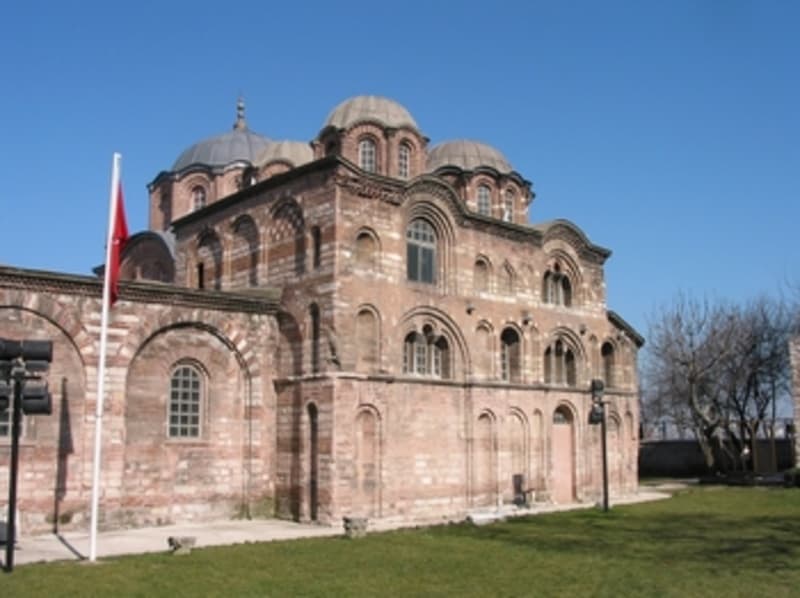
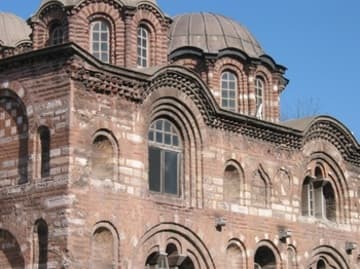
Most of the interior walls of the church were removed to create a large prayer space for the mosque, but most of the original architecture remains intact and 14th-century Byzantine mosaics have survived in the funerary chapel (parakklesion) added in 1315. The mosaics date from about 1320.
The central dome of the parakklesion has a fine mosaic of Christ Pantocrator surrounded by prophets, each labeled with their Greek name and holding banners with Greek phrases:
On the right wall as one faces the apse, near the central dome, is a mosaic of the Baptism of Christ. In addition to Jesus and John the Baptist, the scene includes four angels, a man pouring out water, and a young figure inside a shell. Fish can be seen in the river water.
The apse bears a Deesis mosaic (Christ with the Virgin Mary and John the Baptist) and the chapel's dedicatory inscription: "The nun Marta gave the promise of salvation in the name of her husband, the victorious and deserving protostrator Michael Glabas Ducas." The vault above has mosaics of the Archangels Michael, Uriel, Raphael and Gabriel.
The vaults on both sides of the apse had mosaic portraits of 13 Orthodox bishops; seven of them survive. All hold Bibles and wear vestments embroidered with crosses. The bishops include Clement, Jacob, Gregory, Cyril, Athanasius, Ignatius Theophoros, Gregory of Nyssa, Gregory Thaumaturgus, and Gregory of Agrigentum.
In the southwest corner of the chapel (back of the right aisle when facing the apse) are portraits of six monk saints: Anthony; Euthymius; Sabas; John Climacus; Arsenius; and Chariton.