Highlights from Sacred Destinations
Explore the site
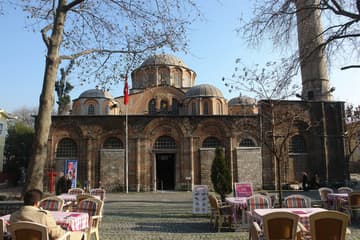
The front (west narthex) of St.
/ Turkey / Kariye Camii (St. Savior in Chora)
Holy Savior
This 11th-century church (later a mosque and now a museum) contains one of the finest preserved galleries of Byzantine mosaics anywhere.
Built in the 11th century and decorated in the 14th, the Church of St. Savior in Chora (formerly the Kariye Camii and now the Kariye Müzesi) in Istanbul contains one of the best-preserved collections of Byzantine mosaics and frescoes anywhere.
The first church on this site was built in the 4th century as part of a monastery complex outside the city walls of Constantinople. This is the reason for the "in Chora" part of its name - chora zonton means "in the country" in Greek. The present building dates from the 11th century.
The interior was restored and richly decorated with mosaics and frescoes in the early 14th century by Theodore Metokhites, Grand Logothete of the Treasury.
When the church was converted into a mosque in the 16th century, the Byzantine mosaics were covered in plaster. This protected them for several centuries. They were first uncovered in the 19th century, but the government ordered that those in the prayer hall section of the mosque be re-covered.
American archaeologists uncovered the mosaics for good during World War II and the church-turned-mosque became a secular museum in 1947.
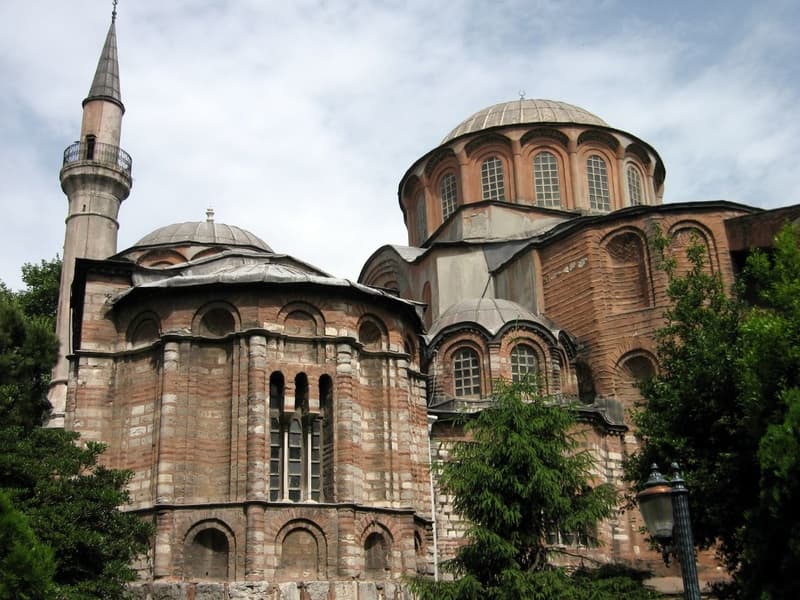
The front (west narthex) of St. Savior in Chora overlooks a small square occupied by a cafe with outdoor tables. Behind the church is a pretty garden with great views of the apses and domes of the church. The bathrooms are back here, too.
Inside, there are about 50 mosaic panels dating from about 1310, most in excellent shape. Virtually all the subjects of the mosaics derive from the New Testament and they are presented in roughly chronological order. Most of the mosaics are in the exonarthex and esonarthex (two lateral west porches). These depict scenes from the life of the Virgin and the early life of Christ.
The later life of Christ was probably depicted in mosaics in the nave (or naos), but now only three mosaic panels survive in this central room: the Dormition of the Virgin over the west door; Christ to the left of the apse; and the Virgin and Child to the right of the apse.
The exonarthex is just inside the west entrance. It is a lateral hall 4 m wide and 23 m long. The subjects of its mosaics include:
The esonarthex runs parallel to the exonarthex between it and the nave. It is also 4m wide but slightly shorter at 18 m long. Its eastern door leads into the nave while a southern door leads into the antechamber of the parecclesion and a northern door leads into a north aisle outside the nave.
The mosaics in the first three bays of the inner narthex depict the Life of the Virgin and her parents Anne and Joachim. The esonarthex has two domes: the smaller above the entrance to the northern corridor; the larger midway between the entrances into the naos and the pareclession.
Mosaic subjects in the esonarthex include the following:
Running along the south side of the central church is a Paracclesion - a burial chamber or mortuary chapel used by the patron and his family. It is decorated with frescoes, which were painted shortly after the mosaics and probably by the same artist. Appropriate to their context in the burial chamber, the frescoesdepict themes relating to the afterlife:
Highlights from Sacred Destinations
Highlights from Sacred Destinations
Advertisement
Advertisement
Advertisement
Where on earth