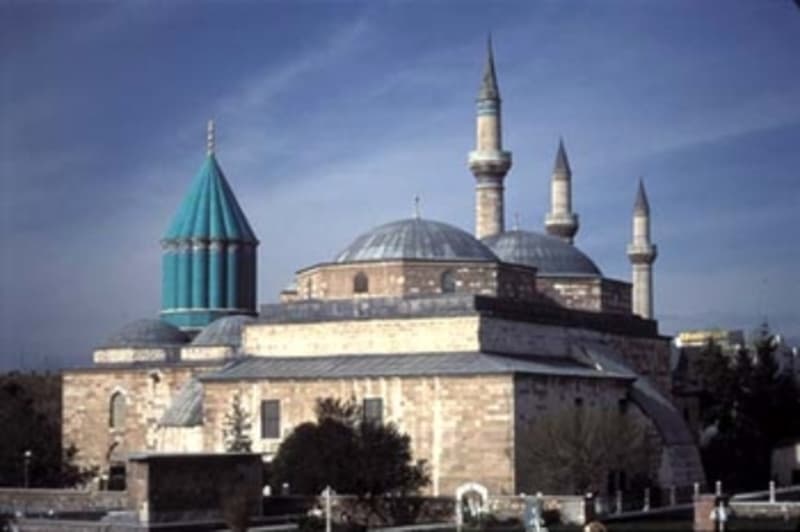
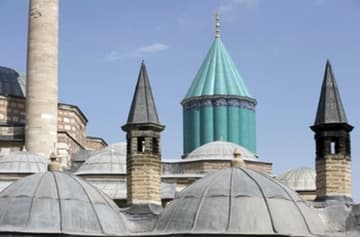
This museum contains the tomb of the 13th-century Sufi saint Mevlana or Rumi, which is an important place of pilgrimage.
The Mevlana Museum (Mevlana Müzesi), also known as the Green Mausoleum or Green Dome, is the original lodge of the Mevlevi Whirling Dervishes, a mystical Sufi Muslim group. It containes the tomb and shrine of the Mevlana, or Rumi, which remains an important place of pilgrimage.
01
History
Sultan 'Ala' al-Din Kayqubad, the Seljuk sultan who had invited Mevlana to Konya, offered his rose garden as a fitting place to bury Baha' ud-Din Walad (or Bahaeddin Veled), the father of Mevlana, when he died in 1231. When Mevlana himself died on December 17, 1273, he was buried next to his father.
Mevlana's successor Hüsamettin Çelebi built a mausoleum (Kubbe-i-Hadra) over the grave of his master. The Seljuk construction, under architect Behrettin Tebrizli, was finished in 1274. Gürcü Hatun, the wife of the Seljuk Emir Suleyman Pervane, and Emir Alameddin Kayser funded the construction.
The cylindrical drum of the of the dome originally rested on four pillars. The conical dome is covered with turquoise faience. Several sections were added until 1854. Selim I decorated the interior and performed the woodcarving of the catafalques.
A decree by Ataturk in September 1925 dissolved all Sufi brotherhoods in Turkey. On April 6, 1926, another decree ordered that the Mevlana mausoleum and dervish lodge be turned into a museum. The museum opened on March 2, 1927.
Special permission granted by the Turkish government in 1954 allowed the Mawlawi dervishes of Konya to perform their ritual dances for tourists for two weeks each year. Despite government opposition the order has continued to exist in Turkey as a religious body. The tomb of Rumi, although officially part of a museum, attracts a steady stream of pilgrims.
Timeline of Mevlana Museum (Green Mausoleum)Auto-play · hover to pause
1231 CESultan 'Ala' al-Din Kayqubad, the Seljuk sultan who had invited Mevl
Sultan 'Ala' al-Din Kayqubad, the Seljuk sultan who had invited Mevlana to Konya, offered his rose garden as a fitting place to bury Baha' ud-Din Walad (or Bahaeddin Veled), the father of Mevlana, when he died in 1231.
2000 BCE1 CE2000 CE
1273 CEWhen Mevlana himself died on December 17, 1273, he was buried next t
When Mevlana himself died on December 17, 1273, he was buried next to his father.
02
What to see
The dervish lodge (tekke) includes a semahane, where the ritual sema or whirling ceremony takes place, a sadirvan for ritual ablutions, a library, living and teaching quarters, and the mausoleum housing the tomb of Celaleddin Rumi, founder of the sect and later awarded the honorable title of Mevlana. His epitaph reads: "Do not seek our tombs on this earth - our tombs are in the hearts of the enlightened."
The mausoleum room is highly ornamented with Islamic script and enameled reliefs, and contains the tombs of several of the more important figures of the dervish order. The main tomb enclosed behind a silver gate crafted in 1597 is that of Mevlana. The tomb of his father, Bahaeddin Veled, is upright and adjacent to his son's, a position that signifies respect.
The adjoining room, or the semihane, is now a museum of Mevlana memorabilia displaying musical instruments and robes belonging to Mevlana, along with Selçuk and Ottoman objects like gold-engraved Korans from the 13th century. Among the fabulous ancient prayer rugs is the most valuable silk carpet in the world.
Highlights from Sacred Destinations
Explore the site
The dervish lodge ( tekke ) includes a semahane , where the ritual sema or whirling ceremony takes place, a sadirvan for ritual ablutions, a library, living and teaching quarters, and the mausoleum housing the tomb of Celaleddin Rumi, founder of the sect and later awarded the honorable title of Mevlana.
Highlights from Sacred Destinations
Look more closely
His epitaph reads: "Do not seek our tombs on this earth - our tombs are in the hearts of the enlightened.