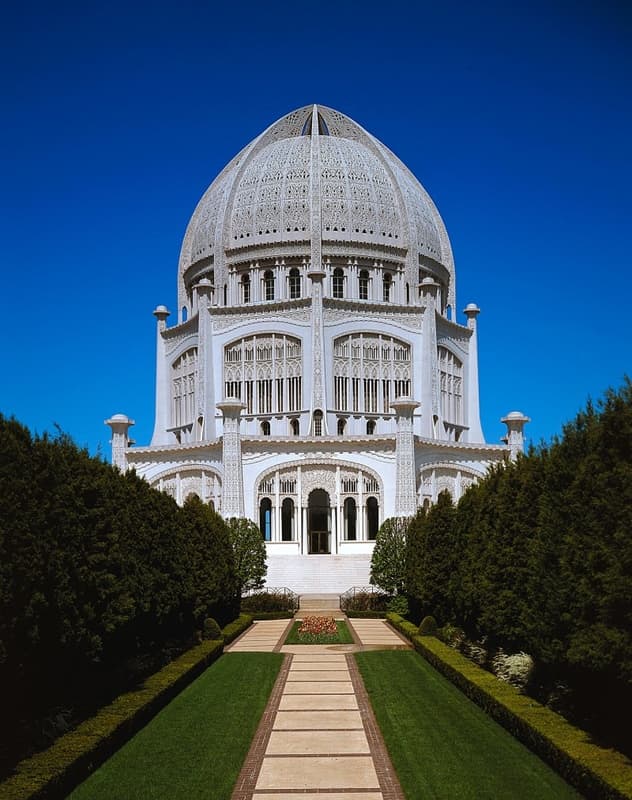
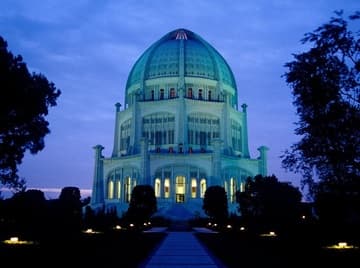
As with all of the Baha’i Houses of Worship, Wilmette’s has nine sides, a towering dome, and is the centerpiece to a brilliantly colorful garden of reflecting pools, endless tulips, and high junipers.
Indeed, the building’s lacelike exterior of cast concrete and quartz make it the most striking “central sculpture” to any garden in the country.
Although it is located in the basement, the visitors center is a necessary stop. The lower level houses a bookshop of Baha’i works as well as a visual history of the temple and representations of the faith.
Upon entering the basement, visitors first see the doors to Foundation Hall, oftentimes with a Baha’i youth waiting to welcome you. Foundation Hall is the original structure and meeting area atop of which the current temple stands.
Most interestingly, however, is a small room in the corner of the lower level. Here, a white, antique rocking chair sits quietly to the side of a large cornerstone.
The cornerstone is of significance not only because it was the first part of the building laid, but also because it was done so by Abdu’l Baha, the son of Bahá’u’lláh.
The rocking chair also has Abdu’l Baha connections: it was owned and used by him during his stay with Baha’is in nearby Kenosha, Wisconsin. Abdu’l Baha was a major propagator and leader of the faith from the 1890s until the 1920s.
Upstairs, the round main temple area (or Auditorium) is flooded with light during the day. The entire interior is covered in delicate, lacy detail.
Baha’i Houses of Worship feature no depictions of figures of the faith, both because Baha’is avoid portraying the founders in art forms and as a sign of respect for other faiths. Baha’i temples are meant to serve as places of interfaith activity, where all people of faiths can worship God.
But there are some particularly Baha’i features in the temple, including: a calligraphic Arabic phrase in the center of the dome (a Baha'i symbol known as the Greatest Name that reads "O Glory of the Most Glorious!"); a few lines from the writings of Bahá’u’lláh bordering the tops of the building’s interior walls; and nine-pointed stars, a symbol commonly used by Baha’is to represent their faith.
In another sign of interfaith recognition, exterior pillars of the temple feature symbols representing some of the world’s faiths, including the Star of David (Judaism), a cross (Christianity), the swastika (an ancient religious symbol), and more. (See photo at right; click to enlarge.)