Highlights from Sacred Destinations
Explore the site
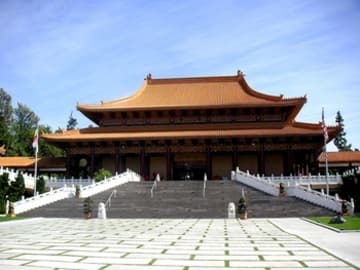
The largest Chinese temple in the United States, Hsi Lai Temple covers 15 acres .
/ California / Hsi Lai Temple
Sacred site · 1978-88
Completed in 1988, this Chinese Buddhist temple and monastery in Hacienda Heights is the largest in the United States.
Hsi Lai Temple is a large Chinese Buddhist temple and monastery in the Hacienda Heights area of Los Angeles, California. Hsi Lai belongs to a new Buddhist order called Fo Guang Shan, which combines Ch'an (Zen) with Pure Land Buddhism and emphasizes Buddhist outreach and unity.
Hsi Lai means "coming to the West" and the temple's mission to spread the Buddha's essential teachings in the west. The temple belongs to the Fo Guang Shan Buddhist Order, whose headquarters are in Taiwan.
The order, whose name means "Buddha's Light Mountain," was founded in 1967 by Venerable Master Hsing Yun. Its headquarters is the largest monastery in Taiwan, covering over 600 acres.
The Fo Guang Shan Order is part of the Lin-Chi sect of of Ch'an (Zen) Buddhism, but it combines the individual striving of Zen philosophy ("self-power") with the savior-devotion of Pure Land Buddhism ("other-power"). Hsing Yun teaches that "Ch'an and Pure Land enhance each other when practiced together... they become like a tiger with horns."
The order's overall emphasis is on Humanistic Buddhism and unity among Buddhist sects and schools. The temple describes Humanistic Buddhism as "a basic philosophy of life that encourages us to integrate the Buddha's teachings of kindness, compassion, joyfulness, and equanimity into our daily lives for the benefit of ourselves as well as others."
Today, over 100 temples worldwide and more than 1,300 monks and nuns belong to the Fo Guang Shan Buddhist Order. Planning and construction of the Hsi Lai Temple in Los Angeles began in 1978 and were completed in 1988.
The stated goals of the Hsi Lai Temple are to: nurture Buddhist missionaries through education, to promote Buddhism through cultural activities, to benefit society through charitable programs, and to edify the populace through Buddhist practices. It also serves as a Chinese cultural center in the area.
" Today, over 100 temples worldwide and more than 1,300 monks and nuns belong to the Fo Guang Shan Buddhist Order.
Its headquarters is the largest monastery in Taiwan , covering over 600 acres.
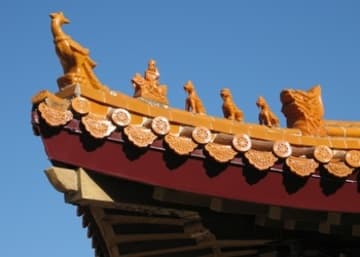
The largest Chinese temple in the United States, Hsi Lai Temple covers 15 acres. It is designed in accordance with Ming (1268-1644 AD) and Ching (1644-1911) dynasty Chinese architecture, and includes several traditional temple buildings, gardens and statuary. The buildings include: a pagoda, a large main shrine building, a bodhisattva shrine, classrooms, a tea room, garden, museum, vegetarian cafeteria, and gift shop. The official website provides an excellent map of the complex.
The main shrine is the most important building in the temple; it is dedicated to Sakyamuni, the historical Buddha. At the front of the shrine are three large Buddha statues: Sakaymuni Buddha in the center; Amitabha Buddha on the left; and the Medicine Buddha on the right. The latter two Buddhas are especially venerated in Pure Land Buddhism.
Across the courtyard, the Bodhisattva Hall contains statues of the five main bodhisattvas and is entered through three doors representing the Three Jewels or Refuges (the Buddha, the Dharma, and the Sangha).
Hsi Lai is a working monastery in addition to a temple, with a number of monks and nuns living in the complex. The monks and nuns of Hsi Lai provide a variety of classes and special events, including weekly lectures on Buddhism and classes as well as workshops on Chinese culture and language. There are weekly prayer services at Hsi Lai Temple on Saturdays and Sundays, including the recitation of the Diamond Sutra and Amitabha Sutra. Meditation sessions are also held, as well as week-long meditation retreats. See the calendar of events for details.
Hsi Lai Temple welcomes visitors (see below for hours and directions) and audio guides on a Walkman are available at the Information Center. Guided tours are provided for groups of 15 people or more (call ahead). The cafeteria serves a Chinese and Taiwanese home-style cooking vegetarian lunch buffet and salad bar for $5 from 11am to 1pm.
Highlights from Sacred Destinations
Highlights from Sacred Destinations
Advertisement
Advertisement
Advertisement
Where on earth