Sacred Destinations

/ New York / Cathedral of St. John the Divine

Cathedral of St. John the Divine

St. John the Evangelist · 1892-present

Cathedral of St. John the Divine

40.8035° N · 73.9617° W|New York City, New York
This Episcopal cathedral on the Upper West Side is the largest cathedral in the world, even though it is still incomplete. It is known for its strong interfaith tradition.

The Cathedral of St. John the Divine in New York City is the largest cathedral in the world (St. Peter's Basilica in Rome is larger, but it's not a cathedral).

Located on the Upper West Side of Manhattan, St. John the Divine is the mother church of the Episcopal Diocese of New York and known for its strong interfaith tradition.

01

History

The first cornerstone of the Cathedral of St. John the Divine was laid in 1892. The difficult building site on the promontory at 112th Street was chosen in 1887 for its prominence and view. The original architects were George Heins and Christopher Grant Lafarge, who beat out 80 other competitors with a Romanesque-Byzantine design.

Notably, the cathedral was (and is still being) contructed using traditional Gothic engineering - blocks of granite and limestone carved by master masons and apprentices - which helps explain its long period of construction.

It took nearly 20 years for just the choir and vaulted dome crossing to be completed, and then due to the death of Heins, a major change of architectural vision took place. It came in 1911 at the hands of Ralph Adams Cram, a Gothic revival purist who insisted on a French Gothic style for the edifice (his work also shaped Princeton University and West Point).

The first services in the nave were held the day before Pearl Harbor (1941), and construction came to a halt after the United States entered World War II. Work did not resume again until 1979, by which time stonecutters were hard to come by. In order to continue building, stonecutters came from Europe to train local craftspeople. The bishop encouraged this method as a way of giving neighborhood youths a valuable skill.

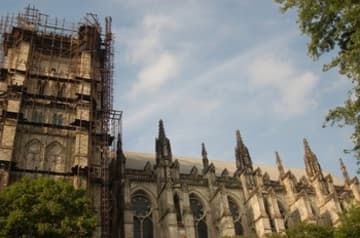
In December 2001, work was halted once again following a firethat damaged the north transept. The cathedral was reopened to visitors within a month, but restoration is still not complete and the financial burden of the fire resulted in construction being temporarily abandoned. Today, construction on the cathedral is about two-thirds complete, with completion not expected anytime soon.

Timeline of Cathedral of St. John the DivineAuto-play · hover to pause
1887 CEThe difficult building site on the promontory at 112th Street was ch

The difficult building site on the promontory at 112th Street was chosen in 1887 for its prominence and view.

2000 BCE1 CE2000 CE
1892 CEJohn the Divine was laid in 1892 .

John the Divine was laid in 1892 .

02

What to see

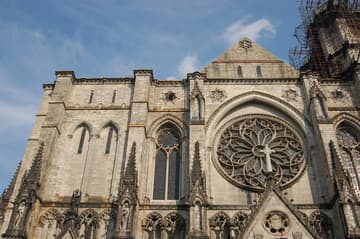
Everything about St. John the Divine is colossal, from its cavernous 601-foot-long nave (the length of two football fields), which can hold some 5,000 worshippers, to its 162-foot-tall dome crossing, which could comfortably contain the Statue of Liberty. And this despite the fact that it is still unfinished! The building's size is best appreciated from Broadway on West 112th Street.

On the Amsterdam Avenue side, wide steps lead up to five portals arching over the entrance doors. The central "Portal of Paradise" depicts St. John witnessing the Transfiguration of Jesus, and 32 biblical characters, all intricately carved in stone.

The 3-ton bronze doors below this portal are decorated with relief castings of scenes from the Old Testament on the left and the New Testament on the right. The doors are opened only twice a year: on Easter and in October for the Feast of St. Francis.

High above the doors, the Great Rose Window, made from more than 10,000 pieces of colored glass, is the largest stained-glass window in the United States.

The Episcopalian cathedral embraces a strong interfaith and intercultural perspective, which can be seen throughout the cathedral's interior. Seven chapels radiate from the ambulatory behind the choir: Ansgar, Boniface, Columba, Savior, Martin, Ambrose and James. Known as the "Chapels of the Tongues," each is dedicated to one of the New York nationalities or ethnic groups who worked on the cathedral.

The Missionary Chapel contains a moving genocide memorial dedicated to the victims of the Ottoman Empire in Armenia (1915-23), of the Holocaust (1939-45), and in Bosnia-Herzegovina since 1992. The FDNY memorial in the Labor Chapel was originally conceived to honor 12 firefighters killed in 1966, but hundreds of personal notes and trinkets of remembrance have transformed it into a moving tribute to the 343 firefighters killed while trying to save others on September 11, 2001.

Other chapels are dedicated to contemporary issues such as sports, poetry, and AIDS. The Saint Savior Chapel contains a three-panel bronze altar in white-gold leaf with religious scenes by artist Keith Haring (his last work before he died of AIDS in 1990).

The more conventional baptistery, to the left of the altar, is an exquisite octagonal chapel with a 15-foot-high marble font and a polychrome sculpted frieze commemorating New York's Dutch heritage.

The altar area includes menorahs, Shinto vases, and, in the Chapels of the Seven Tongues behind the altar, dedications to various ethnic groups. Seventeenth-century Barberini tapestries hang throughout the cathedral.

A precinct of Gothic-style buildings, known as the Cathedral Close, is behind the cathedral on the south side. In a corner by the Cathedral School is the Biblical Garden, with perennials, herbs, and an arbor. Around the bend from here is a rose garden.

Back at Amsterdam Avenue, the Peace Fountain depicts the struggle of good and evil. The forces of good, embodied in the figure of the archangel Michael, triumph by decapitating Satan, whose head hangs from one side. The fountain is encircled by small, whimsical animal figures cast in bronze from pieces sculpted by children.
Highlights from Sacred Destinations

Explore the site

John the Divine is colossal , from its cavernous 601-foot-long nave (the length of two football fields), which can hold some 5,000 worshippers, to its 162-foot-tall dome crossing, which could comfortably contain the Statue of Liberty.
Explore the site

Highlights from Sacred Destinations

Look more closely

And this despite the fact that it is still unfinished!
Look more closely

Advertisement

Advertisement

Advertisement

03

Gallery

10 photographs
04

Location

Where on earth

40.8035° N · 73.9617° WNew York City, New York
Open in Google Maps ↗