Highlights from Sacred Destinations
Explore the site

/ California / Hua Zang Si Temple

Sacred site
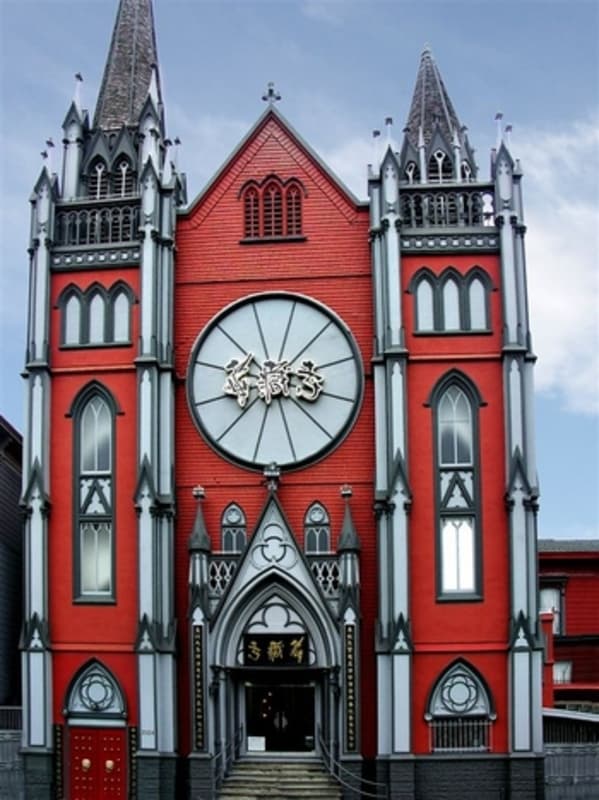
A non-denominational Chinese Buddhist temple, Hua Zang Si is housed in an old Gothic church building in the Mission District of San Francisco.
A non-denominational Chinese Buddhist temple, Hua Zang Si is housed in an old Gothic church building in the Mission District of San Francisco. The temple, which opened in 2004, prides itself on the orthodoxy of its teachings and the rare splendor of its religious treasures.
The impressive building that houses Hua Zang Si was constructed shortly after 1900 as St. John's Evangelical Lutheran Church. Built in a Gothic Revival style, the church served the local German immigrant community who worked at the tanneries and breweries along Precita Creek. The building narrowly escaped the fires that followed the great earthquake of 1906.
By the close of the 20th century, the European immigrant families that remained in San Francisco had mostly moved to the west of the city and the neighborhood welcomed a growing Latino community instead. In 1992, the congregation that met in St. John's Church voted to move to a church around the corner, which would be named St. Mary and St. Martha Lutheran Church.
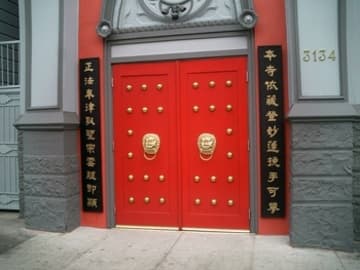
The old Lutheran church was deconsecrated and became a private residence. Plans were underway to turn it into condominiums when the United International World Buddhism Association purchased it and the adjoining parish residence for $2.5 million in 2002. The church building was left intact but given a dramatic makeover with red paint, Chinese-style doors, and a fully remodeled interior.
The temple was opened on December 26, 2004, the birthday of Amidha Buddha, with a ceremony featuring rituals from various traditions. Dharma teacher Jue Hui, a representative of the World Buddhism Association, remarked in her speech:
Some attendees of the ceremony reporting seeing the Buddha Light in the night skies, indicating the Buddha's approval of the temple and its teachings.1
The impressive building that houses Hua Zang Si was constructed shortly after 1900 as St.
The building narrowly escaped the fires that followed the great earthquake of 1906.
The building's multi-faith heritage is clearly in evidence on the wonderfully unique facade: the Gothic architecture is decorated with bright red paint and a German cornerstone referring to the apostles and Jesus Christ stands next to a Chinese text praising the Buddhas.
Inside, the nave has been remodeled to create the Sakyamuni Buddha Hall (also called the Precious Hall of the Great Heroes), dominated by a statue of Shakyamuni Buddha, the historical Buddha whose teachings are the temple's primary focus. Made in Taiwan and reassembled in the temple, the statue receives daily offerings such as coffee, fruit, and even cans of Coke. Standing next to the Buddha is a warrior deity, Skanda Bodhisattva, who protects the temple from evil.
The second floor houses the Amitabha Buddha Hall, with a mandala, a Yun sculpture of Mt. Sumeru that contains Buddhist relics, and a 21-foot-tall statue of Amitabha that was also made in Taiwan. A thousand cups of water, changed daily, are offered before Amitabha, who is the central focus of the Pure Land sect of Buddhism.
An active place of worship and teaching, Hua Zang Si Temple is home to a community of about two dozen Buddhist nuns. Dressed in yellow and gray robes, they rise at 5am and stay up until midnight to meditatate, study, worship and interact with the local community.3
The religious instruction at Hua Zang Si is tailored to "the disciple's particular karmic conditions" and may include:
Highlights from Sacred Destinations

Highlights from Sacred Destinations

Advertisement
Advertisement
Advertisement
Where on earth