Highlights from Sacred Destinations
Explore the site
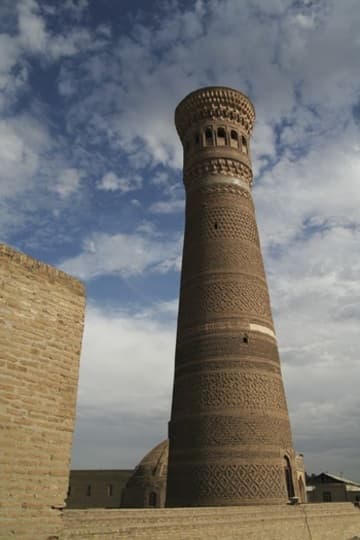
The Kalon Minaret has 14 ornamental bands, each of them different.
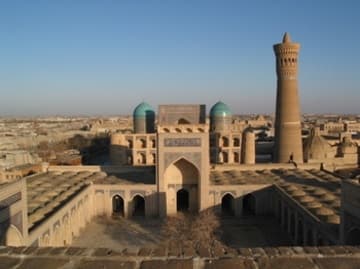
/ Uzbekistan / Kalon Mosque
Sacred site · 16th C
The 12th-century brick Kalon Minaret is one of the most impressive monuments in Bukhara and it can be climbed for fine views. Next to it is the 16th-century Kalon Mosque, built on the site of an earlier mosque.
One of the most impressive monuments in Bukhara, the 12th-century Kalon Minaret can be climbed for fine views over the city. Next to it is the 16th-century Kalon Mosque, built on the site of an earlier mosque.
The Kalon Minaret was built by the Karakhanid ruler Arslan Khan in 1127. According to legend, Arslan Khan had killed an imam in a quarrel. That night, the imam appeared to him in a dream and said: "You have killed me, now oblige me by laying my head on a spot where nobody can tread." Thus the minaret was built over his grave.
When it was built, the Kalon Minaret (whose name means "great" in Tajik) was probably the tallest building in Central Asia. It stands 47m tall and is supported by 10km-deep foundations padded with reeds for earthquake-proofing. In 850 years, it has never needed any structural repairs.
In addition to its main purpose as a minaret, the Kalon Minaret served as a watchtower and a guide to approaching caravans on the Silk Route. In the 18th and 19th centuries, it had more grim use: men condemned by the emir were hurled to their deaths from the top.
Genghis Khan is said to have been so impressed by the minaret that he ordered it spared. He did, however, destroy the original mosque that stood next to it.
The present Kalon Mosque was built in the 16th century. It was used as a warehouse in Soviet times and only reopened as a working mosque in 1991.
In 850 years, it has never needed any structural repairs.
The Kalon Minaret was built by the Karakhanid ruler Arslan Khan in 1127 .
The Kalon Minaret has 14 ornamental bands, each of them different. They include the first use of the glazed blue tiles that became ubiquitous across Central Asia. Slightly lighter patches can be seen on the south and east sides, which were damaged by artillery in 1920.
You can climb the minaret for excellent views over the center of Bukhara. The 105 stairs are accessible from the Kalon Mosque.
The congregational Kalon Mosque can house 10,000 worshippers. Its roof looks flat but actually consists of 288 domes.
Highlights from Sacred Destinations
Highlights from Sacred Destinations
Advertisement
Advertisement
Advertisement
Where on earth