Highlights from Sacred Destinations
Explore the site
At 3,200 square miles in size and up to 1,000 feet in depth, Titicaca is one of the largest, highest, and deepest lakes in the world.
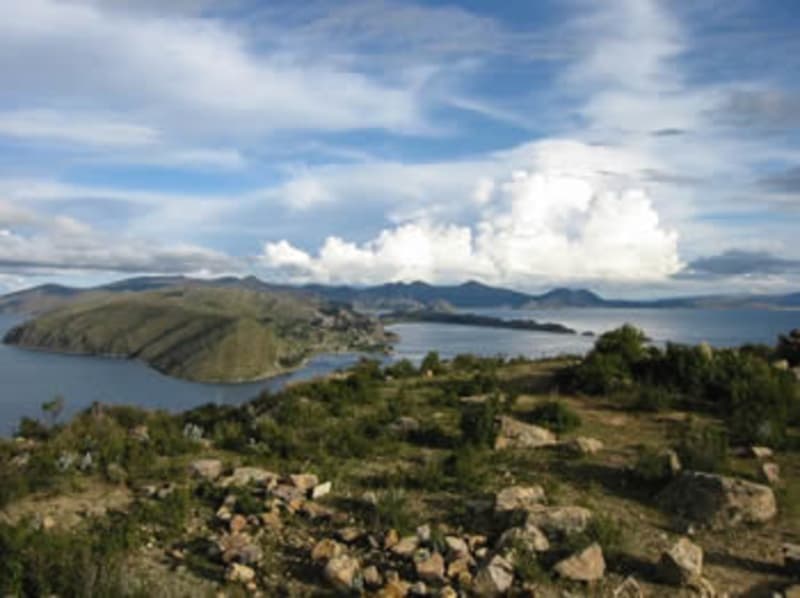
/ Bolivia / Lake Titicaca
Sacred site
Lake Titicaca is a beautiful and much-venerated sacred lake that lies on the border between Peru and Bolivia, near Copacabana .
Lake Titicaca is a beautiful and much-venerated sacred lake that lies on the border between Peru and Bolivia, near Copacabana. According to Incan mythology, it was from Lake Titicaca that the creator god Viracoca rose up to create the sun, moon, stars, and first human beings. Recently, a large temple was discovered submerged in the lake, adding to its mystery and fascination.
In 2000, an international archaeological expedition discovered an ancient temple submerged in the depths of Lake Titicaca. The huge structure is nearly twice the size of a soccer field (660 feet long), and was found by following a submerged road that begins near Copacabana. The temple is estimated to be between 1,000 and 1,500 years old. The Bolivian government has pledged to provide funds for further study of the ruins, and the eventual plan is to bring the temple to the surface. However, locals are fearful about the effects that such disrespect of the sacred lake might bring.
The huge structure is nearly twice the size of a soccer field (660 feet long), and was found by following a submerged road that begins near Copacabana.
In 2000, an international archaeological expedition discovered an ancient temple submerged in the depths of Lake Titicaca.
At 3,200 square miles in size and up to 1,000 feet in depth, Titicaca is one of the largest, highest, and deepest lakes in the world. Like Crater Lake in the USA (also a sacred lake), Lake Titicaca is renowned for its deep blue beauty.
In addition to Lake Titicaca itself, several of the 41 islands in the lake are regarded as sacred. Especially important is the Isla del Sol (Island of the Sun), located on the Bolivia side near Copacabana. The largest of all the lake islands (but still only 5.5 by 3.75 miles in size) , Isla del Sol was regarded as the home of the supreme Inca god Inti.
On the north end of the Island of the Sun is the town of Challapampa, home to the fascinating Chinkana (labyrinth). A huge stone complex full of mazes, it is thought be a training center for Inca priests. Unusually for the Incas, the construction is a bit sloppy—some archaeologists theorize that they must have been in a rush to build it. A natural spring here runs under the island and appears again in a sacred stone fountain in Yumani (see below).
About 270 feet from Chinaka on the path back to the town of Challapampa is a sacred rock carved in the shape of a puma. Further along the path toward Challapampa are two very large footprints. These are said to have been created when the sun dropped down to earth to give birth to Manco Capac and Mama Ocllo, the "Adam and Eve" of the Incas.
On the south end of the Isla del Sol is Yumani, the largest town on the island and the site of the Inca steps. Here, 206 steps built by the Incas lead up into the town and to a sacred fountain. Made of stone and having three separate springs, it is said to be a fountain of youth.
Sunset on the Isla del Sol is magical and best appreciated from the lighthouse on the highest point on the island at 13,441 feet. The sun bathes the sacred mountains in bright colors, and reflects its light in the deep blue of the sacred lake, before sinking below the horizon.
The Island of the Moon (Isla de la Luna) is the legendary home of the Inca goddess Mama Quila. The structures on this island were originally built by the pre-Incan Aymara culture, but the Incas left their mark on the architecture as well (such as the typical trapezoidal doors). During Inca times, the Isla de la Luna housed chosen women known as the "Virgins of the Sun," who lived a nun-like lifestyle. They wove garments from alpaca wool and performed ceremonies dedicated to the sun.
Also of interest are the Uros Islands or Floating Islands (Islas Flotantes), man-made islands of reeds in the Peru side of Lake Titicaca. They are home to the descendents of the ancient Uros culture (contemporary with the now-extinct Incas), who still live a simple, traditional life. Their religion is a mixture of traditional Indian and Catholic, and they bury their dead on the mainland.
Highlights from Sacred Destinations
Highlights from Sacred Destinations
Advertisement
Advertisement
Advertisement
Where on earth