Highlights from Sacred Destinations
Explore the site
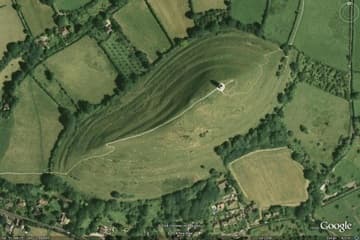
At a height of 521 feet , Glastonbury Tor is is a landmark for miles around.
/ England / Glastonbury Tor
St. Michael
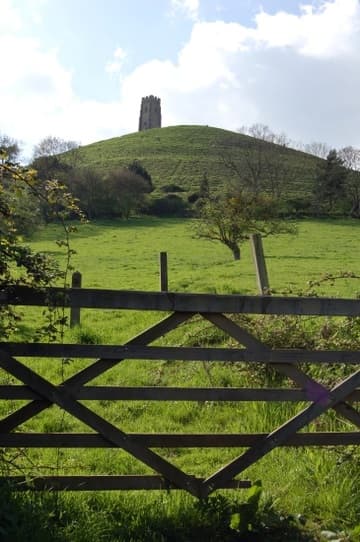
This conical hill, topped by a 14th-century church tower, may have been a place of ancient ritual and it was a place of penance and pilgrimage for Catholics in medieval times.
Glastonbury Tor is a conical hill in Glastonbury, England, which is topped by a 14th-century church tower. Rich in legend and mythological associations, Glastonbury Tor may have been a place of ancient ritual and it was certainly a place of pilgrimage for Catholics in medieval times. Today, it is a popular destination for visiting tourists, Grail theorists, ley-line enthusiasts, and those who make the climb to enjoy its sweeping view of Somerset countryside.
Until two thousand years ago, the sea washed right to the foot of Glastonbury Tor, nearly encircling the cluster of hills. The sea was gradually succeeded by a vast lake. Although a peninsula, the Tor would have looked like an island from most angles of approach: an old Celtic name for Glastonbury is Ynys-witrin, the Island of Glass.
Excavations on the Tor have revealed some Neolithic flint tools and Roman artifacts, indicating some use of the Tor since very ancient times. The terracing on the side of the hill, if man-made, may also date from Neolithic times.
The first significant occupation of the Tor dates from the Early Middle Ages (c.500-1000 AD). Remains discovered from this period include: a metalworker's forge; postholes; two 6th-century burials of teenagers oriented north-to-south; fragments of 6th-century Mediterranean amphorae (for wine or oil); many animals bones; and a worn hollow bronze head which may have topped a Saxon staff.
A second phase of occupation of the Tor between 900 and 1100 AD is known from the discovery of the head of a cross and what were probably monastic cells cut into the rock on the summit. The existence of a monastic community on the Tor is confirmed by a charter of 1243 granting permission for a fair to be held at the Monastery of St. Michael on the hill. Sites on high places are often dedicated to St. Michael the the Archangel; just one examples is Mont St-Michel in Normandy.
The monastery and church on Glastonbury Tor were closely associated with the great Glastonbury Abbey in town below. Medieval pilgrims made the steep climb up Glastonbury Tor with hard peas in their shoes as penance.
The first monastic Church of St. Michael that stood on Glastonbury Tor was probably destroyed in the major earthquake of 1275. The church was rebuilt in the 14th century, and only the tower still stands today.
St. Michael's Monastery on Glastonbury Tor fell into ruin after King Henry VIII's Dissolution of the Monasteries (c.1535) during the English Reformation. The last abbot of Glastonbury, Richard Whiting, was hanged on Glastonbury Tor on November 15, 1539.
500-1000 AD).
A second phase of occupation of the Tor between 900 and 1100 AD is known from the discovery of the head of a cross and what were probably monastic cells cut into the rock on the summit.
At a height of 521 feet, Glastonbury Tor is is a landmark for miles around. From the top of the conical hill, the view encompasses nearby Wells, the Quantocks, the Mendips, peat moors rolling out to sea, and (on clear days) the Welsh mountains.
At the top of the Tor is the 14th-century St. Michael's Tower. Visitors can enter the tower through wide archways on either side; and inside are stone benches and an informational plaque about Glastonbury Tor and St. Michael's Tower.
Highlights from Sacred Destinations
Highlights from Sacred Destinations
Advertisement
Advertisement
Advertisement
Where on earth