Highlights from Sacred Destinations
Explore the site
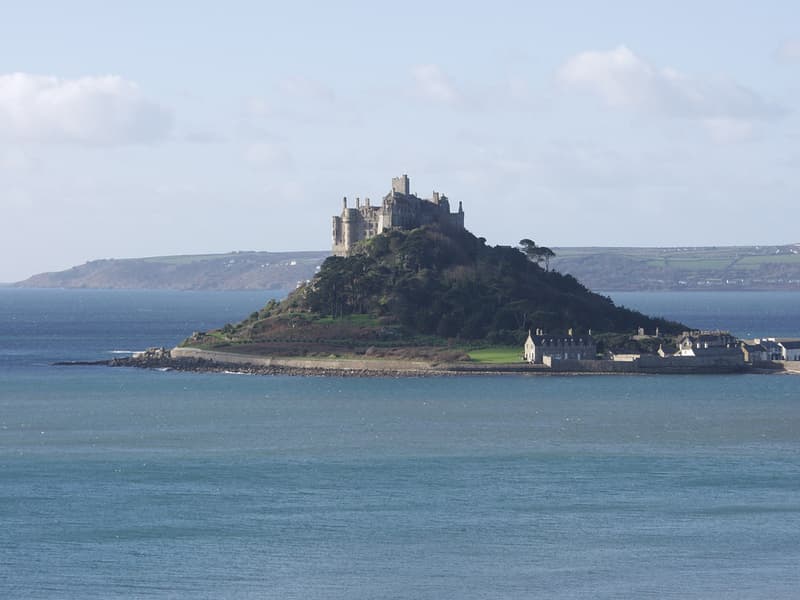
Michael's Mount is not as impressive as its French namesake, but it is still a spectacular sight, perched on a rocky hill and surrounded by blue waters.
/ England / St. Michael's Mount
St. Michael · 1135-44
This ancient abbey in Cornwall is England's parallel to Mont-St-Michel across the channel in France. Both were founded after visions of the Archangel Michael and only accessible during low tide.
St. Michael's Mount is a rocky island 5 miles south of Penzance in Cornwall, England. Surmounted by an fortress-like abbey dedicated to St. Michael the Archangel, this atmospheric sacred site has much in common with its namesake across the channel, Mont-St-Michel in France.
In Classical times (about 400 BC to 400 AD), the Mount was an important port for the export of tin and copper to Europe. It is thought to be the island of Ictis referred to in classical literature.
In 495 AD, a vision of St. Michael the Archangel led to the building of a church dedicated to him on the rocky mount. A few centuries later, a Celtic monastery was established on St. Michael's Mount. A Christian grave dating from c.900 AD was recently discovered there.
Edward the Confessor (r.1042-66) built a chapel on the mount and handed over the abbey to the Benedictine Mont-St-Michel in France.
The present church was begun in 1135 by Abbot Bernard of Mont St. Michel and consecrated by the Bishop of Exeter in 1144. The church was a major pilgrimage destination throughout the Middle Ages thanks to the ancient vision of St. Michael.
In 1193, the abbey was seized by Henry de la Pomeray, who disguising his men as pilgrims. He began to build a castle, but committed suicide in fear of the consequences when Richard the Lionheart returned from the Crusades.
Four miracles were reported in the church on St. Michael's Mount in 1262 and 1263, which led to increasing numbers of pilgrims.
In the following centuries, St. Michael's Mount gradually began to separate itself from its French counterpart across the Channel: in 1385 Richard Auncell of Tavistock became the first non-French prior, and in 1424 Henry VI granted the monastery to Syon Abbey instead of Mont St. Michel.
During the Hundred Years War, King Henry V appropriated the mount, and it became a fortress after the abbey's dissolution a century later (1548). In 1588, the first beacon to warn of the arrival of the Spanish Armada was lit at St. Michael's Mount.
The castle was used to store arms for the Royalist forces during the English Civil War. After the war, Colonel St. Aubyn purchased the Mount (1659); his descendents still live in the castle today.
In 1846, Queen Victoria and Prince Albert make an impromptu visit to the Mount while cruising on the Brittannia. The St. Aubyn family were not at home, so the royals were entertained by the housekeeper in the Blue Drawing Room.
In 1954, St Michael’s Mount was given to the National Trust, with the St. Aubyn family to retain a 999 year lease to live in the castle and a licence to operate the visitor business. The National Trust now ensures the preservation and conservation of the Mount and manages its visitors.
In Classical times (about 400 BC to 400 AD), the Mount was an important port for the export of tin and copper to Europe.
In Classical times (about 400 BC to 400 AD), the Mount was an important port for the export of tin and copper to Europe.
The abbey on St. Michael's Mount is not as impressive as its French namesake, but it is still a spectacular sight, perched on a rocky hill and surrounded by blue waters. At low tide, the Mount is approached by a historic stone causeway, used by pilgrims in the Middle Ages.
There are many buildings to explore on the mount, many of which date from the 12th century. The battlemented Chapel is lovely and is still a place of pilgrimage. Behind the altar are three 15th-century alabaster panels that were crafted in Nottingham; no one is quite sure how or when they came to be at St Michael’s Mount. The west end of the church contains a fine 15th-century rose window with early 20th-century glass.
The attractive library was formerly the breakfast room and now contains over 1,300 books. Two cozy-looking red velvet chairs face a large fireplace and there is a fine Italian gaming table (for chess, drafts and card games) from the 19th century, which it has belonged to the St. Aubyn family ever since it was made.
The Chevy Chase Room is perhaps the most impressive room on St. Michael's Mount. Formerly the abbey's refectory, it contains a 17th-century plaster frieze of hunting scenes that runs around the entire room and gave it its name. In the windows are fragments of painted glass of Dutch and Flemish origin and of varying dates.
The Blue Drawing Room, named for its baby-blue wall paint, displays portraits and landscape paintings by Cornish painter John Opie. Known as "The Cornish Wonder," Opie left Cornwall to make his fortune in London; many of his works can now be seen in the National Portrait Gallery.
The Map Room houses an interesting curiosity – a model of St Michael’s Mount made from champagne corks. It was made in 1932 by Henry Lee, a butler in service at the castle.
The Garrison Room displays a collection of weapons including muskets, musket balls, Cromwellian armor, and even a Samurai suit of armor that was given to Lord St. Aubyn.
Over the back of the Mount is a dizzying view down to the sea and over the castle's impressive sub-tropical gardens.
Highlights from Sacred Destinations
Highlights from Sacred Destinations
Advertisement
Advertisement
Advertisement
Where on earth