Highlights from Sacred Destinations
Explore the site
The pleasant village of Iguerande is located atop a small hill surrounded by scenic farmland.
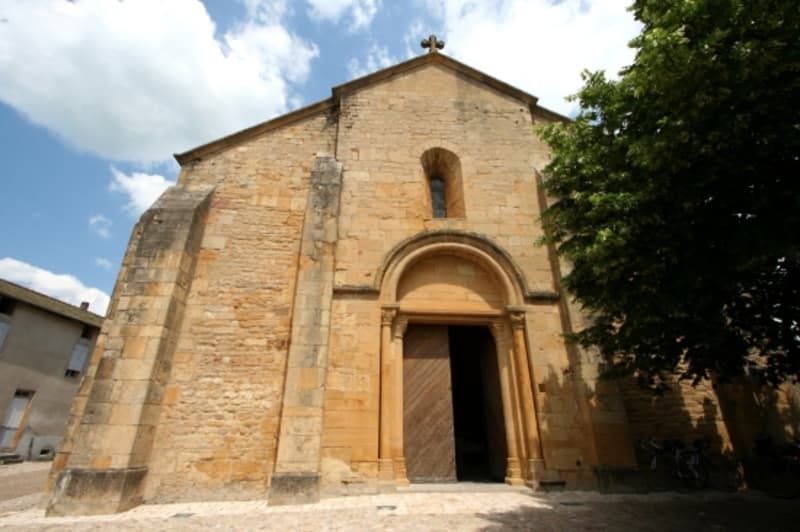
/ France / Iguerande Church
St. Andrew (now St. Marcel) · c. 1088-1100
This squat, solid Romanesque church in southern Burgundy is notable for its 11th-century architecture and interesting sculptures, including a cyclops playing a pan-flute.
Iguerande Church is a squat, solid Romanesque church in the Brionnais region of southern Burgundy, noted for its well preserved 11th-century architecture and many interesting sculptures, including a cyclops playing a pan-flute.
Iguerande is named for the Gallic word Awaranda, which means a boundary marked by a river. In ancient times, Iguerande was the boundary between two cities belonging to the Gallic tribes known as the Eduens and Arvernes.
Sometime after the Christianization of the area, a church was built in Iguerande. In 1088, it came under the authority of Cluny Abbey (overseen by the Prioress of Marcigny) and was rebuilt as a church for a small priory of Benedictine monks. It was completed around 1100.
The priory had already disappeared by the time of the French Revolution, when Iguerande Church was designated a parish church in the diocese of Maçon. It was dedicated to St. Andrew the Apostle.
Iguerande Church is still often called St-André, but it is now dedicated to St. Marcel, a 2nd-century martryr. Back when the church was part of a priory, there was a Chapel of St. Marcel in Iguerande that served as the parish church; it was destroyed in the early 1800s.
In 1088 , it came under the authority of Cluny Abbey (overseen by the Prioress of Marcigny) and was rebuilt as a church for a small priory of Benedictine monks.
It was completed around 1100.
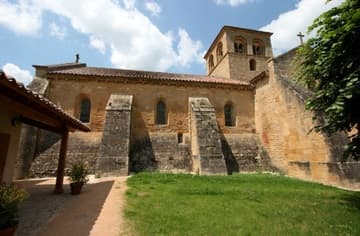
The pleasant village of Iguerande is located atop a small hill surrounded by scenic farmland. A grassy field south of the church is currently (2008) occupied by llamas.
Iguerande Church is a squat, solid edifice with heavy buttressing on the exterior. Inside, it consists of a three-bay nave with side aisles, a transept topped with a crossing tower, a short choir with ambulatory and apse, and two east apsidoles. The southern apsidole has been enclosed inside a square chapel. The apses are decorated with corbels carved with an interesting variety of animals, humans and birds.
The nave has round arches and barrel vaults; the side aisles have groin vaults. The nave has no direct lighting, but the tall arches of the arcades let in some light from the aisle windows. The nave is supported by square pillars with engaged columns, which are topped with interesting carved capitals.
Most of the capitals have foliage decoration, but one in the north aisle depicts a fascinating pair of creatures: a cyclops playing a pan-flute and a cow-like creature who may be playing a harp. Musical monsters and demons are a common theme in Romanesque sculpture and were meant to teach the wickedness of non-sacred music.
Unusually, there are figurative sculptures on the column bases as well. They are more rustic in style than the capitals and include the head of a calf, the head of a demon, and another head of a calf that is shown upside down for some unknown reason.
The transept crossing is covered by a fine octagonal cupola on squinches, which supports a square bell tower. The tower has two levels of bell-openings separated by cornices and a low pyramid roof. The overall design is similar to that of Saint-Martin-d'Ainay in Lyon.
Highlights from Sacred Destinations
Highlights from Sacred Destinations
Advertisement
Advertisement
Advertisement
Where on earth