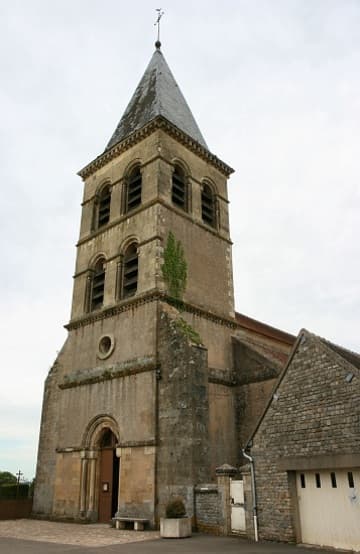
The 12th-century Church of St. Reverianus in Burgundy was once a priory church affiliated with Cluny and a stop for pilgrims to Santiago de Compostela. It has important Romanesque capitals in the choir and late medieval frescoes in the apse.
Dating from the early 12th century, the Église St-Révérien (Church of St. Reverianus) in northwest Burgundy was once a priory church affiliated with Cluny and a stop for pilgrims on the way to Santiago de Compostela. Today it serves as the parish church of the village of Saint-Révérien. It has an attractive nave, important Romanesque capitals in the choir, and late medieval frescoes in the apse.
01
History
The church and village are named for St. Reverianus, a missionary-bishop of Autun who was martyred by beheading in the late 200s. An oratory was built on the site of his tomb, followed by a Benedictine monastery. The monastery was originally under the diocese of Autun, was transferred to the diocese of Nevers under Charles the Gros in 880, and finally passed to the Abbey of Cluny in 1055.
It was Cluny that oversaw the rebuilding of the priory church and its monastic buildings in the early 12th century, sending its own masons to work on it. The priory's location and connection with Cluny (which developed and promoted the pilgrimage) made Saint-Révérien a common stop for pilgrims on their way to Santiago de Compostela.
The church's fortunes went into sharp decline in the early 16th century, when it was put under the authority of commendatory priors (appointed by rulers, not elected by monks), who tended to be absent and neglectful. Most of the monastic buildings disappeared over time.
A disastrous firein 1723 destroyed the parish church of Saint-Révérien as well as the west end of the priory church. The latter was patched up and became, in 1725, the parish church of the village. The nave was rebuilt in the 19th century in the style of the destroyed original.
Belonging to the old Observance, its disappearance was precipitated since 1768, before l' stop of Louis XVI of 1788. L' church prieurale is classified under the Historic buildings, and remain of this animated history the home of the prior and the barn, as well as the old part of the farm of the priory, the tower dovecote and bakery with its furnace, all private properties.
Timeline of Saint-Révérien ChurchAuto-play · hover to pause
880 CEThe monastery was originally under the diocese of Autun , was transf
The monastery was originally under the diocese of Autun , was transferred to the diocese of Nevers under Charles the Gros in 880, and finally passed to the Abbey of Cluny in 1055.
2000 BCE1 CE2000 CE
1055 CEThe monastery was originally under the diocese of Autun , was transf
The monastery was originally under the diocese of Autun , was transferred to the diocese of Nevers under Charles the Gros in 880, and finally passed to the Abbey of Cluny in 1055.
02
What to see
Despite the fire, significant parts of the Cluniac Romanesque church still survive intact: the chevet (east end) with its radiating chapels, the choir with its original capitals, and the angels on the west portal. Near the church, on private property, are some survivors of the priory buildings: the prior's house and barn (15th century), the dovecote (12th/13th century) and the bakery.
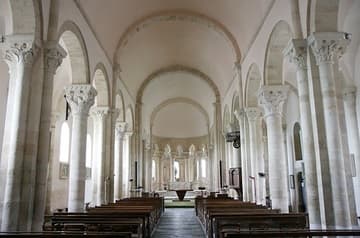
Entrance is through the west door, watched over by two Byzantine-style angels stretched out under the arch. Inside, there is a large porch beneath the west tower. The rebuilt nave is airy and full of light. It has a barrel vault, supported by side aisles with a pointed-arch groin vault.
The lovely choir is the only one in Burgundy without a clerestory. It is slightly elevated and surrounded by an ambulatory, which has three radiating chapels. The vault of the central chapel is decorated with frescoes from the 16th century.
The capitalsin the choir are very interesting and important survivals of Cluniac art. The sculptors are thought to have come from the abbey of La Charité-sur-Loire. We know the name of one of them - a capital in the ambulatory bears the inscription "ROTBERTVS ME FECIT" (Rotbertus made me). Most subjects are mythical animals and entwined foliage, but two capitals use all four of sides to tell a biblical story:
Highlights from Sacred Destinations
Explore the site
Despite the fire, significant parts of the Cluniac Romanesque church still survive intact: the chevet (east end) with its radiating chapels, the choir with its original capitals, and the angels on the west portal.
Highlights from Sacred Destinations
Look more closely
Near the church, on private property, are some survivors of the priory buildings: the prior's house and barn (15th century), the dovecote (12th/13th century) and the bakery.