Highlights from Sacred Destinations
Explore the site
Today, the Portara is one of Naxos' most famous landmarks and is connected to Naxos Town by a man-made causeway.
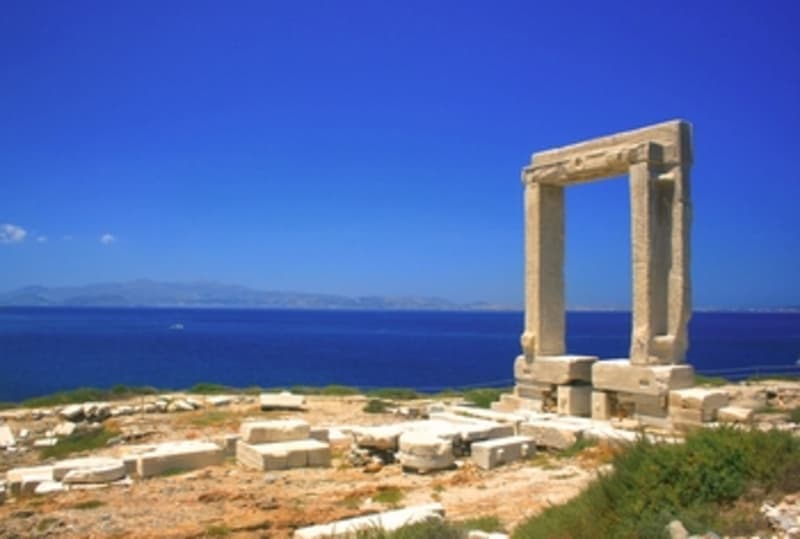
/ Greece / Portara
Apollo · 530 BCE
This iconic door that leads nowhere is the entrance to an unfinished Temple of Apollo that faces exactly toward Delos, the god's birthplace. It was begun about 530 BC.
The most famous landmark of Greece's Naxos Island is the Portara, a massive 2,500-year-old marble doorway that leads nowhere.
The Portara stands on Palatia, which was once a hill but is now a separate little island connected to Naxos by a causeway. (The Mediterranean has risen significantly since ancient times.)
The Portara is the entrance to an unfinished temple that faces directly toward Delos, Apollo's birthplace. For this reason most scholars believe it was dedicated to Apollo, but some think it was built in honor of Dionysus, who was worshipped on Naxos Island.
Whichever god it was dedicated to, the temple was begun about 530 BC by the tyrant Lygdamis, who said he would make Naxos's buildings the highest and most glorious in Greece. Only the walls were mostly completed when he was overthrown in 506 BC; the temple was never finished. Evidence from pottery indicates the temple's cult was abandoned by the 5th century BC.
By the 5th and 6th centuries AD, the temple had been converted into a church. Under Venetian and Turkish rule the temple was dismantled so its marble could be used to build a castle. The doorway, however, was so large and heavy it could not be used, so it remains standing alone among the ruins.
Whichever god it was dedicated to, the temple was begun about 530 BC by the tyrant Lygdamis, who said he would make Naxos's buildings the highest and most glorious in Greece.
Only the walls were mostly completed when he was overthrown in 506 BC; the temple was never finished.
Today, the Portara is one of Naxos' most famous landmarks and is connected to Naxos Town by a man-made causeway. It picturesquely overlooks the ocean, so that with a bit of imagination it might be a portal to another world.
The rectangular door stands 26 feet (8m) high and is made of four blocks of marble, each 16 feet long and weighing 20 tons. The tenons (projections for lifting the blocks) were never removed, providing insight into the methods of temple construction.
Some of the foundations and temple floor have also survived. From this, archaeologists have discerned that the temple was going to be 181 feet long by 80 feet wide and enclosed within an outer colonnade of six Ionic columns on the ends and 12 or 13 on the long sides. It was to have porches and an inner shrine with a double colonnade.
Highlights from Sacred Destinations
Highlights from Sacred Destinations
Advertisement
Advertisement
Advertisement
Where on earth