Highlights from Sacred Destinations
Explore the site
The 4th-century Byzantine church has been partially reconstructed and provides a good sense of what the original was like.
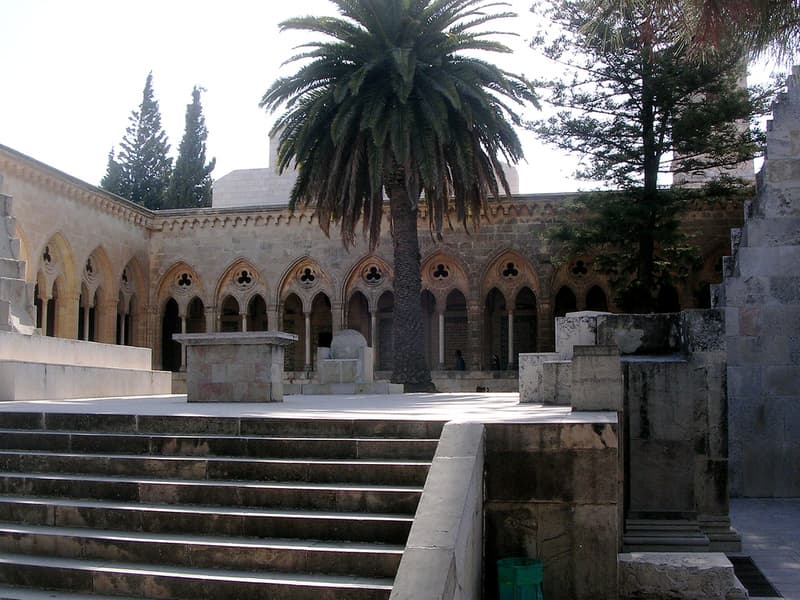
/ Jerusalem / Church of the Pater Noster
Sacred site
Built on the traditional place where Jesus instructed his disciples in prayer, the walls of this convent church are inscribed with the Lord's Prayer in 44 languages.
Named for the "Our Father" prayer (Latin: Pater Noster), the Church of the Pater Noster stands on the traditional site in Jerusalem where Jesus taught his disciples the Lord's Prayer. Emperor Constantine built a church over a cave here in 4th century, and this has been partially reconstructed. Plaques in the cloister bear the Lord's Prayer in 62 different languages.
The Gospel account provides almost no information on the location of Jesus' teaching of the Lord's Prayer, also known as the "Our Father." The 3rd-century Acts of John (ch. 97) mentions the existence of a cave on the Mount of Olives associated with the teaching of Jesus, but not specifically the Lord's Prayer.
The church historian Eusebius (260-340) recorded that Constantine built a church over a cave on the Mount of Olives that had been linked with the Ascension. (Other Constantinian churches built over a cave are the Church of the Holy Sepulchre and the Church of the Nativity in Bethlehem.) The church was built under the direction of Constantine's mother St. Helen in the early 4th century and was seen by the Bordeaux pilgrim in 333. The pilgrim Egeria (384) was the first to refer to this church as Eleona, meaning "of olives."
When the site for the veneration of Christ's ascension had been moved up the hill (see Chapel of the Ascension), this cave became exclusively associated with Jesus' teachings on the conflict between good and evil (Matt 24:1-26:2). Here Egeria heard this Gospel passage read on Tuesday of Holy Week.
Like many buildings in Jerusalem, the Constantinian church suffered destruction by the Persians in 614. The memory of Jesus' teaching remained associated with this site, but the content of that teaching shifted from good and evil to the Our Father prayer. This new identification was based on a clever harmonization of Luke 10:38-11:4 with Mark 11:12-25 (the withered fig tree).
When the Crusaders arrived, the site was associated specifically with the Lord's Prayer. They constructed a small oratory amidst the ruins in 1106, and a church was rebuilt in 1152 thanks to the funds of the Bishop of Denmark, who was buried in it with his butler. 12th-century pilgrims mention seeing marble plaques with the Lord's Prayer inscribed in Hebrew and Greek at the church. Excavations have uncovered an inscribed Latin version.
The Crusader-era church was damaged in 1187 and destroyed by 1345. In 1851 the remaining stones of the 4th-century church were being sold to Jews for tombstones in the Valley of Jehoshaphat.
The site was finally rescued by the Princesse de la Tour d'Auvergne, who bought the land and began a search for the cave. In 1868 she built a cloister modeled on the Campo Santo at Pisa and founded a Carmelite convent to the east in 1872.
In 1910, the Byzantine foundations over the cave were found partly beneath the cloister. The cloister was moved and the Byzantine church began to be reconstructed in 1915. The project is still unfinished.
The church historian Eusebius (260-340) recorded that Constantine built a church over a cave on the Mount of Olives that had been linked with the Ascension.
Helen in the early 4th century and was seen by the Bordeaux pilgrim in 333.
The 4th-century Byzantine church has been partially reconstructed and provides a good sense of what the original was like. The half-restored church has the same dimensions as the original; the garden outside the three doors outlines the atrium area.
The unroofed church has steps leading down into the cave, which was partially collapsed when discovered in 1910. It is an interesting medley of ancient rock cuttings, concrete supports and marble furnishings. The cave cuts partly into a 1st-century tomb.
Left of the church's south door is an area paved with mosaics and identified as a baptistery. The 19th-century cloister is in a European style and upholds the tradition of multilingual plaques bearing the Lord's Prayer - 62 tiled panels display the prayer in 62 different languages, from Aramaic to Japanese to Scots Gaelic. The tomb of the Princesse de la Tour d'Auvergne is on the south side of the cloister.
The lane to the right of the convent's entrance leads to the Russian Church of the Ascension, established 1887. Its white tower can be seen from the Old City on a clear day. Byzantine tomb chapels with some lovely Armenian mosaics are preserved in the small museum.
Highlights from Sacred Destinations
Highlights from Sacred Destinations
Advertisement
Advertisement
Advertisement
Where on earth