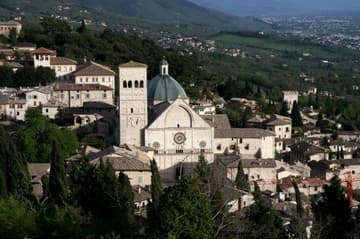
Assisi's cathedral is dedicated to San Rufino, the bishop who first brought Christianity to the city. St. Francis and St. Clare were baptized here.
Built in the 12th century after a miraculous vision by the local bishop, the cathedral of Assisi (Assisi Cattedrale; Duomo di San Rufino) is not anywhere near as famous as the Basilica di San Francesco, but it is well worth seeking out for its beautiful Romanesque facade and historic font.
01
History
The Duomo's piazza is believed by some historians to be the site of Assisi's Roman forum. The first church on this spot may have been built as early as the 5th century. Ever since its foundation it has been dedicated to St. Rufino, the 3rd-century bishop who brought Christianity to Assisi and was martyred here.
In 1028, Assisi's bishop witnessed a miraculous event (the details of which were not recorded) and had the old church torn down and a Romanesque one built to replace it. It was accompanied by a stout bell tower built over a Roman cistern, which still stands today.
In 1134, however, another bishop had an even greater miraculous vision, and the century-year-old church was flattened to make way for the present structure. Only the bell tower was retained from the 11th-century building. In the century it took to build the new church, the Romanesque styling of the lower two-thirds of the facade gave way to Gothic fashion in the top third.
The interior was remodeled in 1571 following structural damage.
Timeline of Duomo di San RufinoAuto-play · hover to pause
1028 CEIn 1028 , Assisi's bishop witnessed a miraculous event (the details
In 1028 , Assisi's bishop witnessed a miraculous event (the details of which were not recorded) and had the old church torn down and a Romanesque one built to replace it.
2000 BCE1 CE2000 CE
1134 CEIn 1134 , however, another bishop had an even greater miraculous vis
In 1134 , however, another bishop had an even greater miraculous vision , and the century-year-old church was flattened to make way for the present structure.
02
What to see
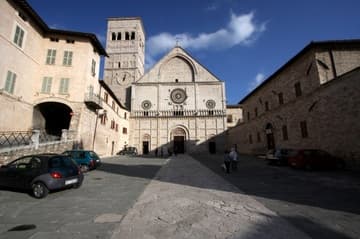
The Duomo's west facade is mainly Romanesque, and features highly decorative friezes, lions and griffins guarding the doors, wheel-shaped rose windows, and a classical arcade of slender colonettes. The Gothic top third is rather plain, decorated only with a pointed blind arch.
The interior is mainly notable for the fontin which St. Francis, St. Clare, and Emperor Frederick II were baptized (on the right inside the entrance). The altar bears paintings of the Crucifixion and the Deposition.
A door at the end of the left aisle leads to the Museo della Cattedrale, which preserves detached frescoes by Puccio Capanna, more works by Dono Doni, and triptychs by L'Alunno and Matteo da Gualdo along with a small archaeological collection.
You can enter the cathedral crypt from the door to the right of the facade; its rough vaulting and Ionic columns are, along with the bell tower, the only surviving bits of the 11th-century cathedral.
Highlights from Sacred Destinations
Explore the site
The Duomo's west facade is mainly Romanesque, and features highly decorative friezes, lions and griffins guarding the doors, wheel-shaped rose windows, and a classical arcade of slender colonettes.
Highlights from Sacred Destinations
Look more closely
The Gothic top third is rather plain, decorated only with a pointed blind arch.