Highlights from Sacred Destinations
Explore the site
Modeled on the mother house at Cîteaux (France), San Galgano Abbey is a prime example of Cistercian architecture.
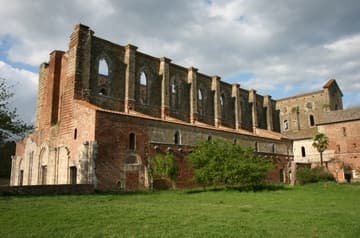
/ Italy / San Galgano Abbey
St. Galganus · 1244-88
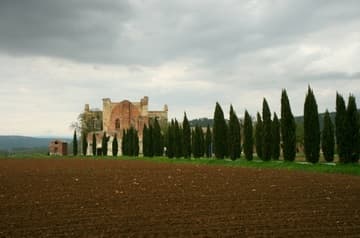
Picturesquely located in the rural fields of Tuscany near Siena, this Cistercian abbey was built in the 13th century and now stands in graceful ruins.
Picturesquely located in the rural fields of Tuscany, San Galgano Abbey is a ruined Cistercian monastery dating from the 13th century.
The Abbey of San Galgano was founded by Cistercian monks from Casamari Abbey. They dedicated the new foundation to St. Galganus (d.1181), a hermit who lived on the hill above the abbey. The abbey was constructed around 1224-88.
The monks of San Galgano were exceptionally powerful and played a major role in the affairs of nearby cities. Their many duties included resolving disputes between such cities as Siena and Volterra and even overseeing the construction of Siena Cathedral.
The abbey declined in the 16th century due to a long period of corruption that culiminated with an abbot selling the lead from the church roof, which soon collapsed. The monastery was eventually abandoned and the church was deconsecrated. Although the roof is still missing and the cloister has mostly disappeared, the abbey remains remarkably intact today.
1181), a hermit who lived on the hill above the abbey.
The abbey was constructed around 1224-88.
Modeled on the mother house at Cîteaux (France), San Galgano Abbey is a prime example of Cistercian architecture. Like most Cistercian abbeys, it is austerely Romanesque in style, except for the graceful pointed arches that would become a hallmark of Gothic architecture.
The wide west facade, made of brick with stone cladding on the lower half, has three portals and two lancet windows. The east end is in the unique Cistercian style, with a flat facade rather than a round apse. The east end has round window above and small pointed lancet windows below.
The walls of the abbey church remain fully intact, with only the roof open to the sky. The capitals of the nave are finely carved with simple foliage designs, some of which include a small bird or human face.
The detached rectangular cemetery chapel, highly picturesque among fields on the north side, also dates from the 13th century.
Highlights from Sacred Destinations
Highlights from Sacred Destinations
Advertisement
Advertisement
Advertisement
Where on earth