Highlights from Sacred Destinations
Explore the site
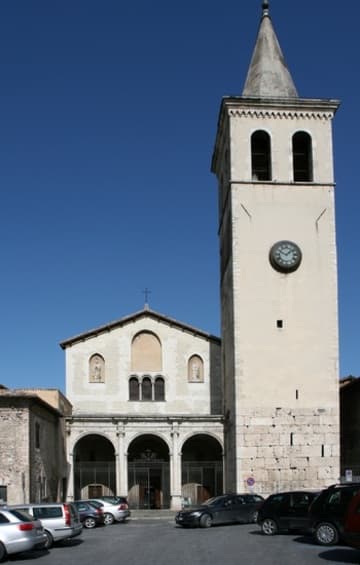
Overlooking the bustling Piazza Garibaldi in the Lower Town, San Gregorio incorporates elements from a variety of eras, including remains of an earlier 8th-century church.
/ Italy / San Gregorio Maggiore
St. Gregory · 1069
Built in 1069, San Gregorio has an exterior made with Roman spoils and an interior with patches of Romanesque frescoes, unusual stone confessionals, and a little crypt.
The 11th-century Romanesque church of San Gregorio Maggiore in Spoleto has ancient origins, an atmospheric interior and some interesting medieval frescoes.
The present Church of San Gregorio was mostly built in the 11th century on the site of an ancient oratory dedicated to St. Gregory, a local saint killed in a spectacle at Spoleto's Roman amphitheater in 304 AD. According to tradition, 10,000 other martyrs died along with him; they are honored here, too.
Careful restorations in the 1950s removed most of the Baroque additions to reveal the original Romanesque architecture.
Overlooking the bustling Piazza Garibaldi in the Lower Town, San Gregorio incorporates elements from a variety of eras, including remains of an earlier 8th-century church.
The base of the campanile (with large visible blocks) dates from the Early Christian period, while the top was last refined in the 16th century. The Romanesque facade dates from the 12th century and is modeled on the Duomo.
The large Renaissance porch was added in the 16th century and contains the Cappella degli Innocenti (Chapel of the Innocents), now protected by a gate and used as a baptistery. It is decorated with frescoes depicting the life of St. Abundatius, who is buried in the crypt.
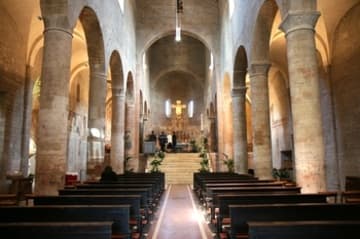
The interior is in the solid Romanesque style of the 11th century, decorated on some walls with fragments of 14th-century frescoes by local Umbrian artists. The presbytery is full of architectural spoils from various eras, including some 6th-century Byzantine capitals and a medieval Cosmatesque pavement. It is raised several meters above the nave on tiny, mismatched pillars.
Below the presbytery is an atmospheric little crypt with a groin vault and a forest of pillars.
Highlights from Sacred Destinations
Highlights from Sacred Destinations
Advertisement
Advertisement
Advertisement
Where on earth