Highlights from Sacred Destinations
Explore the site
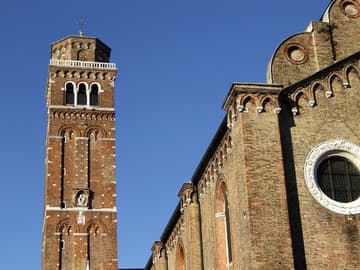
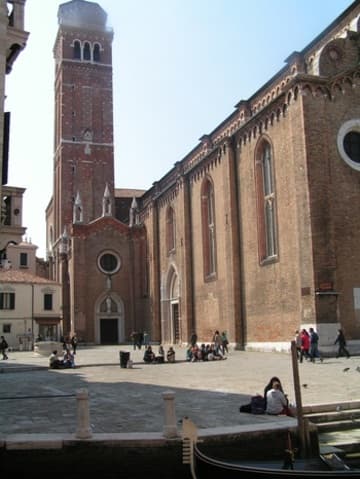
The imposing Frari is built of brick in the Italian Gothic style.
/ Italy / Santa Maria Gloriosa dei Frari
Assumption of the Virgin · 1330
A Franciscan church built in 1330, I Frari is best known for its masterpieces by Titian and other artists.
The Santa Maria Gloriosa dei Frari (St. Mary of the Friars), known locally as i Frari, is one of the greatest churches of Venice. It stands on the Campo dei Frari at the heart of the San Polo district of the city. The church is dedicated to the Assumption of Mary (Assunzione della Beata Virgine) and is notable for its many masterpieces of Venetian Renaissance art and monuments to Renaissance sculptors and artists.
The Franciscanswere granted land to build a church here in 1250, but the building was not completed until 1338. Work almost immediately began on its much larger replacement, the current church, which took over a century to build. The campanile, the second tallest in the city after that of San Marco, was completed in 1396.
The Franciscans were granted land to build a church here in 1250, but the building was not completed until 1338.
The Franciscans were granted land to build a church here in 1250, but the building was not completed until 1338.
The imposing Frari is built of brick in the Italian Gothic style. The exterior is deliberately plain in accordance with the Franciscan emphasis on poverty and austerity.
The interior is light and spacious. It contains the only rood screen still in place in Venice and many excellent examples of Renaissance art.
Look for Titian's Madonna di Ca' Pesaro in the left aisle. The Virgin was modeled after the artist's wife, who died in childbirth soon after. Titian's Assumption of the Virgin, over the main altar, was unveiled in 1518. It was not initially accepted by the church because of the innovative style and bright colors, especially the trademark red, but these features would later make it famous.
Titian himself, who died of the plague in 1576, is buried in a monumental tomb in the church.
In the sacristy is Giovanni Bellini's triptych Madonna and Child with Saints (1488), painted for precisely this spot. The Corner Chapel on the other side of the chancel features Bartolomeo Vivarini's altarpiece St. Mark Enthroned and Saints John the Baptist, Jerome, Peter, and Nicholas (1474).
Other notable works include the pyramid-shaped monument to sculptor Antonio Canova (1757-1822) on the left aisle and Donatello's John the Baptist, his first documented work in Venice.
Highlights from Sacred Destinations
Highlights from Sacred Destinations
Advertisement
Advertisement
Advertisement
Where on earth