Highlights from Sacred Destinations
Explore the site
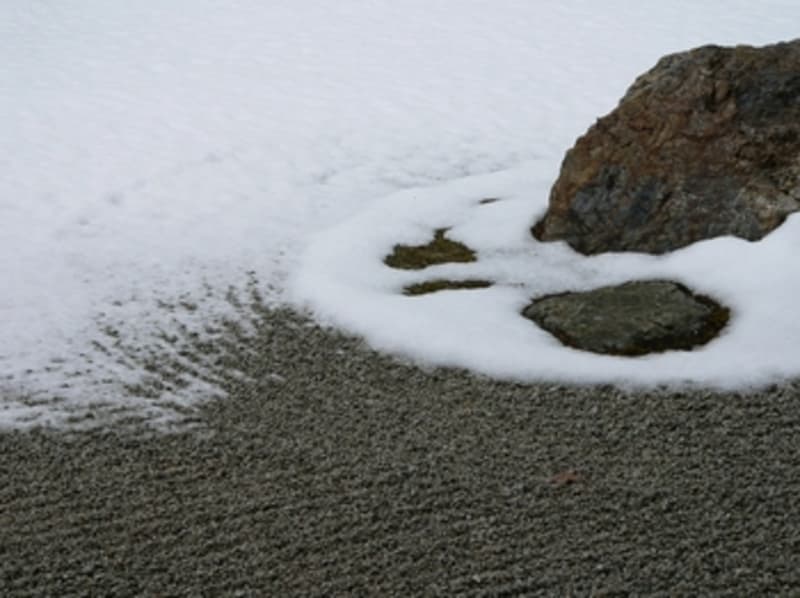
Ryoanji is most famous for its karesansui (dry landscape) Zen rock garden , thought to date from the late 1400s.
/ Japan / Ryoanji
Sacred site
A World Heritage Site famed for its Zen rock garden.
Ryōanji (Peaceful Dragon Temple) is a Zen temple and World Heritage Site in northwest Kyoto, Japan. It is best known for its Zen garden, a simple gravel-and-rock arrangement that inspires peace and contemplation.
The site of the temple was originally a Fujiwara family estate during the Heian period. The temple was founded in 1450 by Hosokawa Katsumoto (1430-73), a military leader in the Muromachi period.
The original temple buildings burned down during the Onin Wars (1467-77), in which Katsumoto was killed. The temple was reconstructed from 1488 to 1499, and Ryoanji's famous rock garden was probably constructed around this time. Further reconstructions and additions were made over the centuries.
The temple belongs to the Myōshinji school of the Rinzai branch of Zen Buddhism. Rinzai Zen was introduced to Japan by the Chinese priest Ensai in 1191 and emphasizes the use of koans, paradoxical puzzles or questions that help the practitioner to overcome the normal boundaries of logic.
Rinzai Zen was introduced to Japan by the Chinese priest Ensai in 1191 and emphasizes the use of koans , paradoxical puzzles or questions that help the practitioner to overcome the normal boundaries of logic.
The temple was founded in 1450 by Hosokawa Katsumoto (1430-73), a military leader in the Muromachi period.
Ryoanji is most famous for its karesansui (dry landscape) Zen rock garden, thought to date from the late 1400s. It is one of the most notable examples of the dry-garden style — some say it is the highest expression of Zen art and teachings and perhaps the single greatest masterpiece of Japanese culture. No one knows who laid out this simple garden, or precisely when, but it is today as it was yesterday, and tomorrow it will be as it is today.
The Zen garden is an austere arrangement of 15 rocks rests on a bed of white gravel, surrounded by low walls. The moss-covered boulders are placed so that, when looking at the garden from any angle, only 14 are visible at one time. In the Buddhist world the number 15 denotes completeness. So you must have a total view of the garden to make it a whole and meaningful experience, and yet, in the conditions of this world, that is not possible.
Unlike Stonehenge, the Pyramids, or Angkor Wat, Ryoanji can hardly impress you with technical achievement, religious imperative or sheer scale. Yet its quiet minimalism inspires contemplation and introspection.
Behind the simple temple that overlooks the rock garden is a stone washbasin called Tsukubai, which is said to have been contributed by Tokugawa Mitsukuni in the 17th century. It bears a simple but profound four-character inscription: "I learn only to be contented." This is the heart of Zen philosophy.
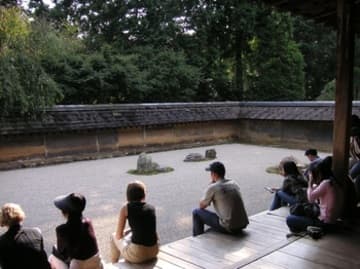
The main temple building is a meditation hall (hojo) furnished with tatami mats, sliding doors, and a small Buddhist altar. It opens onto the veranda that overlooks the rock garden.
The temple grounds cover 120 acres, including the scenic mountain backdrop, and are well worth a stroll, particularly the cool green moss gardens and large pond. Due to its large population of waterbirds, it is popularly known as Oshidori-ike, the pond of mandarin ducks. The pond has two small islands, the larger of which is has a small bridge leading across to a shrine to Benten, the Shinto goddess of good luck.
On the rim of the pond is a beautiful little restaurant, Ryoanji Yudofuya, with tatami rooms and screens. Here you where you can eat yudofu or have an expensive beer and enjoy the view.
Highlights from Sacred Destinations
Highlights from Sacred Destinations
Advertisement
Advertisement
Advertisement
Where on earth