Highlights from Sacred Destinations
Explore the site
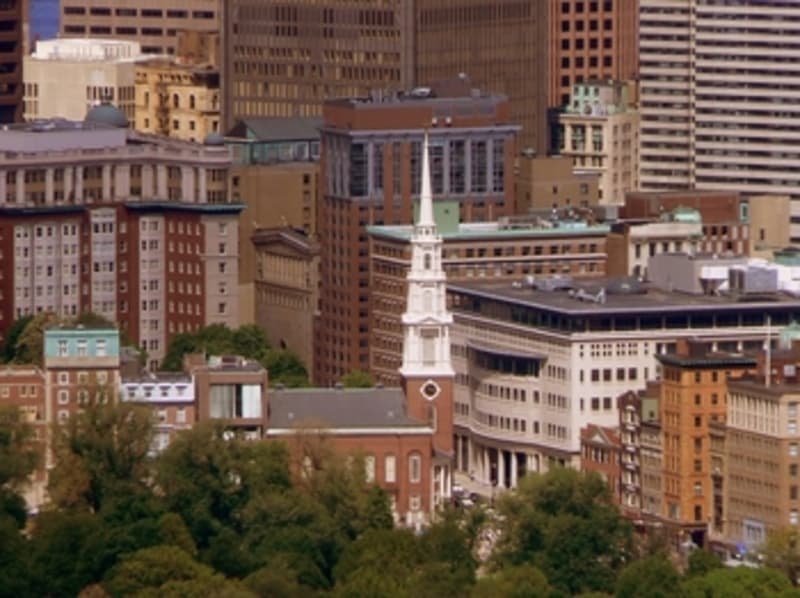
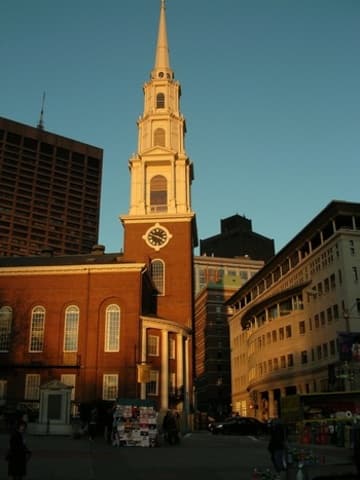
Park Street is characterized by a fine 217-foot steeple , which was once the tallest landmark in downtown Boston.
/ Massachusetts / Park Street Church
Sacred site · 1809
Founded in 1809 as a bastion of Trinitarian orthodoxy against the Unitarian movement, this Congregational church with a tall spire has played a major role in Boston's history and remains vibrant today.
Park Street Church is a historic Congregational church on the Freedom Trail in Boston. Founded in 1809 as a bastion of Trinitarian orthodoxy against the growing Unitarian movement, this Puritan church with a tall spire has played an important role in Boston's religious and political history.
Park Street Church was founded in 1809 by 26 conservative Christians, most of them former members of the Old South Church. The Articles of Faith and Government set down at the time of its founding laid out the church's mission:
Park Street Church was built in record time and consecrated less than year later. The construction work included tearing down the Old Granary Building (built 1728), in which the the sails for the U.S.S. Constitution were sewn.
Sunday services were a serious business in the early years. Sermons were two to three hours long and sticks were kept on hand to rap the heads of dozing adults and misbehaving children. In addition, two men were employed on Sundays to patrol the church grounds and chastise any children found playing or climbing trees in Boston Common.
Over the years Park Street pioneered a number of ministries, including the longest-running radio broadcast program in the country and the first prison ministry program in America. Some guidebooks also credit Park Street with America's first Sunday school program but this is not the case - Methodist Sunday schools have been active since 1790.
Gunpowder was stored in the church's basement during the War of 1812, which accounts for the site's nickname of "Brimstone Corner" (though this describes equally well the sort of sermons that have resounded from Park Street's pulpits over the centuries).
In 1816 Park Street Church joined with Old South Church to form the City Mission Society, a social service society to serve Boston's urban poor.
In 1829, William Lloyd Garrison preached his first abolitionist sermon from the pulpit of Park Street Church. Some members of the congregations thought he should be lynched. On July 4, 1831, the familiar patriotic hymn My Country 'Tis of Thee (a.k.a. America) was sung here for the first time.
Today, Park Street remains firm in its conservative Trinitarian theology and has a vibrant, predominantly young congregation. The church hosts a fellowship meeting of young adults called "Seekers" on Sunday afternoons and two youth-oriented serves on Sunday evenings. It is well known for its college and international outreach programs.
Park Street Church is already planning celebrations for its "Remember - Rejoice - Rededicate" bicentennial in 2009.
The construction work included tearing down the Old Granary Building (built 1728), in which the the sails for the U.
Some guidebooks also credit Park Street with America's first Sunday school program but this is not the case - Methodist Sunday schools have been active since 1790.
Park Street is characterized by a fine 217-foot steeple, which was once the tallest landmark in downtown Boston. This and other aspects of the architecture is inspired by designs of the renowned English architect Christopher Wren (best known for St. Paul's Cathedral and numerous other churches in London).
The church's architecture is traditionally Puritan, with austere decoration and a pulpit in the center of the sanctuary to emphasize the importance of preaching. The interior was originally fitted with box-pews, but these were replaced by the present row pews in 1880.
Unusual for a Puritan church is the single stained-glass window, added in 1904. But to downplay any potential ostentation, a plain-glass window has been placed over it so that the colorful decoration is invisible from the street.
Visitors are welcome to look around the church during open hours or by appointment (see below) and church volunteers are on hand to answer questions. A five-minute film explains the congregation's rich history and photographs in the hallway record such historic events as the church interior being draped in black after Lincoln's assassination.
Highlights from Sacred Destinations
Highlights from Sacred Destinations
Advertisement
Advertisement
Advertisement
Where on earth