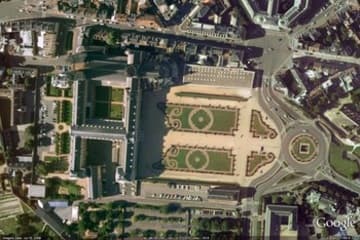
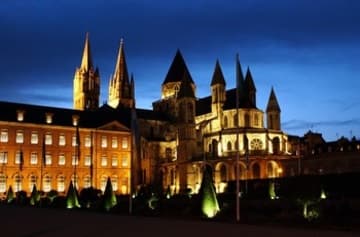
The Men's Abbey was founded by William the Conquerer in the 11th century. Its church, the Romanesque Église St-Etienne, is the largest and most impressive church in Caen.
The Abbaye-aux-Hommes (Abbey for Men) was founded by William the Conquerer in the 11th century. Its abbey church, the Romanesque Église St-Etienne, is the finest in Caen.
01
History
The Abbaye-aux-Hommes was founded by William the Conqueror in 1067 as penance for marrying his cousin, Matilda (who founded the Abbaye aux Dames for the same reason). The Conqueror himself was buried in the church.
The Early Gothic choir replaced the original Romanesque sanctuary in 1202. The earliest example of Norman Gothic, it became the model for many subsequent choirs.
William the Conqueror's tomb was destroyed by Huguenots in 1562 during the Wars of Religion - only a hipbone was recovered. Then the last of William's dust was scattered in the French Revolution.
Additions to the abbey were made in the 18th century and its elegant buildings are now part of City Hall. During the height of the Allied invasion in World War II, residents of Caen huddled in St-Etienne Church for protection.
Timeline of Abbaye aux HommesAuto-play · hover to pause
1067 CEThe Abbaye-aux-Hommes was founded by William the Conqueror in 1067 a
The Abbaye-aux-Hommes was founded by William the Conqueror in 1067 as penance for marrying his cousin, Matilda (who founded the Abbaye aux Dames for the same reason).
2000 BCE1 CE2000 CE
1202 CEThe Early Gothic choir replaced the original Romanesque sanctuary in
The Early Gothic choir replaced the original Romanesque sanctuary in 1202 .
02
What to see
The church of the Abbaye aux Hommes is made from local Caen stone (also used for Canterbury Cathedral, Westminster Abbey, and the Tower of London) and is a Norman Romanesque masterpiece, with a severe unadorned facade flanked by twin Romanesque towers topped with Gothic spires. Rising 84m (276 ft.) high, these helped earn Caen the nickname "city of spires." There is another Romanesque tower over the crossing.
Inside is a long Romanesque nave of the 11th century with a sexpartite vault (a transitional vault on the way to Gothic), an 11th-century transept, and a 13th-century Gothic choir with ambulatory.
An inscribed marble slab in the choir marks the site of William the Conqueror's tomb. Other notable sights include the hand-carved wooden doors and elaborate wrought-iron staircase.
Adjoining the church on the south are the abbey buildings, which were rebuilt in the 18th century. After the Revolution they were occupied by the Lycée Malherbe and now house the Town Hall. The abbey rooms are richly decorated with wrought-iron banisters, fine paneling, and the town's collection of paintings. There is also a large refectory. The cloisters provide a nice view of the church towers.
Highlights from Sacred Destinations
Explore the site
The church of the Abbaye aux Hommes is made from local Caen stone (also used for Canterbury Cathedral , Westminster Abbey , and the Tower of London) and is a Norman Romanesque masterpiece, with a severe unadorned facade flanked by twin Romanesque towers topped with Gothic spires.
Highlights from Sacred Destinations
Look more closely
) high, these helped earn Caen the nickname "city of spires.