Highlights from Sacred Destinations
Explore the site
The Sacré-Coeur was paid for by national subscription, and its iconography is distinctly nationalistic .
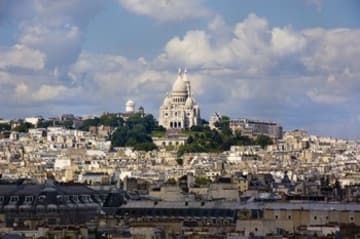
/ France / Sacré-Coeur
Sacred Heart · 1875-1919
This 19th-century basilica and landmark is built over the place to which St. Denis is said to have carried his own head after his martyrdom.
The Basilique Sacré-Coeur (Basilica of the Sacred Heart) is a Roman Catholic church and familiar landmark in Paris, located on the highest point of the city in Montmartre.
The site of the 19th-century basilica is traditionally associated with the beheading of the city's patron, Saint Denis, in the 3rd century. According to legend, after he was martyred, Bishop Denis picked up his severed head and carried it several miles to the north, where the suburb of Saint-Denis stands today.
After France's 1870 defeat by the Prussians in the Franco-Prussian War and its aftermath, the Commune of 1871, the basilica was planned as a guilt offering and a vote of confidence to cure France's misfortunes.
The church was dedicated to the Sacred Heart of Jesus, a cult that gained popularity after 1873, when the first pilgrimage was organized to Paray-le-Monial in Burgundy. It was there that revelations encouraging prayer to Christ's sacred heart had been reported in the 17th century.
The foundation stone of the Basilique Sacré-Coeur was laid in 1875. It was consecrated in 1891, fully completed in 1914, and elevated to the status of a basilica in 1919, after the end of the First World War.
After France's 1870 defeat by the Prussians in the Franco-Prussian War and its aftermath, the Commune of 1871, the basilica was planned as a guilt offering and a vote of confidence to cure France's misfortunes.
After France's 1870 defeat by the Prussians in the Franco-Prussian War and its aftermath, the Commune of 1871, the basilica was planned as a guilt offering and a vote of confidence to cure France's misfortunes.
The Sacré-Coeur was paid for by national subscription, and its iconography is distinctly nationalistic. It has much in common, both historically and architecturally, with the Basilica Notre-Dame de Fourviere in Lyon.
Designed by Paul Abadie in a Romanesque-Byzantine architectural style, the Sacré-Coeur was inspired by St-Front in Perigueux (Dordogne), a multi-domed Romanesque church the architect had recently restored.
The triple-arched portico is surmounted by two bronze equestrian statues of France's national saints, Joan of Arc and King Saint Louis IX, designed by Hippolyte Lefebvre.
Even the great bell, the Savoyarde, has nationalist references: Savoy was annexed to France in 1860. Cast in Annecy in 1895, it is one of the world's heaviest bells at 19 tons.
The Sacré-Coeur Basilica is built of Château-Landon (Seine-et-Marne) stone, a frost-resistant travertine that bleaches with age to a gleaming white. The main portal has grand bronze doors with foliage designs.
Inside, the Sacré-Coeur is dim and rather gloomy except for the golden mosaics glowing from apse. The floor plan is an equal-armed Greek cross, with a large dome (83m high) over the crossing. In the huge choir, 11 tall round arches support a barrel vault.
The bronze altar is based on the one at Cluny Abbey in Burgundy. Since 1885, the Blessed Sacrament has been continually on display in a monstrance above the high altar. Perpetual adoration of the Blessed Sacrament has continued uninterrupted in the Basilica since 1885.
The apse mosaic, designed by Luc-Olivier Merson (1922), is the largest in the world. It depicts Christ in Majesty and The Sacred Heart worshiped by the Virgin Mary, Joan of Arc and St. Michael the Archangel.
A climb to the top of the dome provides an excellent view of Paris - at 271 feet above Montmartre it is the second-highest viewpoint after the Eiffel Tower - and the walk around the inside of the dome alone is worth the climb. The dome is supported by 80 columns, each topped with a different capital.
The crypt contains statues of saints and a relic that some believe to be the very Sacred Heart (Sacré-Coeur) of Christ.
At the rear of the grounds is a contemplative garden and fountain.
Highlights from Sacred Destinations
Highlights from Sacred Destinations
Advertisement
Advertisement
Advertisement
Where on earth