Hailes Abbey
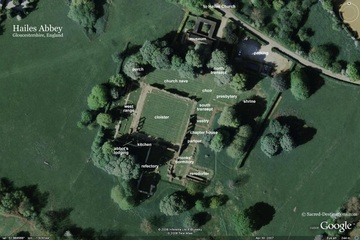
Hailes Abbey is a ruined Cistercian monastery in Gloucestershire that was once a major medieval pilgrimage destination. Founded by the brother of King Henry III in 1246, it was dissolved by King Henry VIII in 1539.
History of Hailes Abbey
In October 1242, Richard, Earl of Cornwall, found himself in grave danger at sea. Terrified, he vowed to God that if he was saved from shipwreck, he would found a monastery. He did live, and he fulfilled his vow with the help of his brother King Henry III, who gave him some land at Hailes in 1245.
At the time, there was a small settlement at Hailes. The Cistercians, whose rules required them to live "far from the concourse of men," normally built their monasteries in remote, desolate areas. But in this case the royal gift of land did not allow the monks choice of location, so the settlement of Hailes was simply removed! The villagers were relocated to Didbrook a few fields to the north, and all that remained at Hailes was the parish church.
The Cistercians now had the isolation they required, and they began to build a monastery in 1246. The founding monks (20 of them plus 10 lay brothers) came from the Abbey of Beaulieu in Hampshire. Within five and a half years, enough of the abbey was completed to be dedicated. The dedication ceremony was held on November 5, 1251, in the presence of King Henry III, his brother Richard who founded the abbey, Queen Eleanor, a number of nobles and 13 bishops.
In 1270, John, Abbot of Beaulieu, visited Hailes Abbey and ordered that alms be given at the gate, indicating this usual practice had ceased for financial reasons. (Indeed, in 1260 the previous abbot had been concerned about the abbey's debts.) Abbot John also had to remind the monks of Hailes to observe the rule of silence.
Hailes Abbey's fortunes took a dramatic turn for the better in 1270, the same year Abbot John visited. Earl Richard's son, Edmund, presented to the community a vial containing the blood of Christ, which he had purchased from the Count of Flanders in 1267. The relic of the Holy Blood came with a guarantee of the Patriarch of Jerusalem (later Pope Urban IV) that it was authentic.
A shrine was specially built in the abbey church for the relic and the Holy Blood was enshrined with great ceremony on September 14, 1270. It immediately became a pilgrimage destination and the faithful continued to flock to the shrine from all over the country throughout the Middle Ages. In 1533, Hugh Latimer wrote, "I live within half a mile of the Fossway and you would wonder to see how they come by flocks out of the West Country to many images but chiefly to the Blood of Hailes."
The history of Hailes Abbey came to an end with the Reformation and the Dissolution of the Monasteries. First, in 1538, King Henry VIII ordered that all Catholic shrines be demolished. The Holy Blood of Hailes was removed from its shrine on October 28, 1538, and brought to London for inspection. On November 24 the Bishop of Rochester displayed the relic and declared that it was "honey clarified and colored with saffron, as had been evidently proved before the King and his Council."
The last Abbot of Hailes was Stephen Sagar, who came from the Abbey of Whalley in Lacashire and appears to have been friends with Thomas Cromwell. On Christmas Eve 1539, Abbot Sagar and his 21 monks surrendered Hailes Abbey to King Henry's commissioners. The abbey was found to be worth £357, making it the 12th richest of the 75 Cistercian abbeys in the country. The head commissioner, Dr. London, reported to Cromwell that he "found the father and all his brethren very honest and conformable persons and the house clearly out of debt." Abbot Sagar received a pension of £100 a year; the monks received £8 a year or less.
In 1542, the king sold Hailes Abbey to Richard Andrews, a dealer in former monastic property, and the great abbey church was destroyed shortly thereafter. The west range, barn and other useful buildings were preserved and later used as private housing for noble families.
By the end of the 18th century the site had suffered extensive destruction and it was left in an overgrown and decaying state until its excavation in the late 1800s. Hailes Abbey was donated to the National Trust in 1937. Today is it managed by English Heritage and attracts a significant number of visitors.
What to See at Hailes Abbey
The remains of Hailes Abbey are not extensive, but the rural setting is peaceful, green and scenic. None of the abbey church survives, but the outline of its foundations has been excavated and is the first sight visitors encounter.
Walk to the left down the length of the church - the square base in the center of the east end is where the Shrine of the Holy Blood once stood.
To accommodate all the pilgrims, the east end of the abbey church was extended with the addition of an ambulatory and a chevet (apse with radiating chapels). This design was common on the Continent but rarely found in England and especially not in Cisterician monasteries, which were supposed to built on the ideals of simplicity and austerity. The flower-like outline of the chevet is still clearly visible.
Adjoining the church is the cloister, which still retains some of its fine arches. Off the left side of the cloister is the remains of the chapter house, where four round bases indicate the positions of the pillars that supported the vaulted ceiling. Adjacent to that is the narrow parlour, which was the only room in the monastery where conversation was permitted.
Across the cloister from the church stretches the refectory, where the monks ate their meals in silence while readings were given from a lectern built into the side wall.
The visitors' center at Hailes Abbey includes a fine little museum, where the items of chief interest are carved ceiling bosses from the chapter house. One depicts Samson defeating the lion, which was a symbol of Christ defeating sin. There are also floor tiles decorated with coats of arms and various items from the site's later history as a private manor.
On your way out, don't miss the little Hailes Church across the street, which is older than the abbey and contains 13th-century wall paintings.
Getting There
Hailes Abbey is just 2 miles northeast of Winchcombe in Gloucestershire, off the B4632. There is no public transportation and the last part of the journey is on a (paved) single-track road, but a taxi from Cheltenham or Winchcombe may be possible.
Quick Facts on Hailes Abbey
| Site Information | |
| Names: | Hailes Abbey |
|---|---|
| Categories: | abbeys; ruins |
| Faiths: | Cistercian order |
| Dates: | 1246 |
| Status: | ruins |
| Visitor and Contact Information | |
| Coordinates: | 51.968604° N, 1.928353° W |
| Address: | Hailes, England |
| Lodging: | View hotels near Hailes Abbey |
References
- Personal visit (May 5, 2007)
- J.G. Coad, Hailes Abbey (English Heritage guidebook).
- Hailes Abbey - English Heritage
- Hailes - Cistercians in Yorkshire
More Information
- Photos of Hailes Abbey - here on Sacred Destinations
Map of Hailes Abbey
Below is a location map and aerial view of Hailes Abbey. Using the buttons on the left (or the wheel on your mouse), you can zoom in for a closer look, or zoom out to get your bearings. To move around, click and drag the map with your mouse.