The Holy Mosque, Mecca
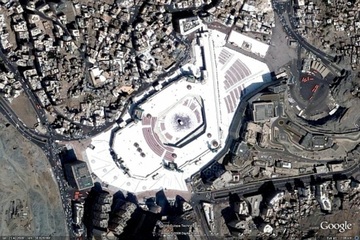
Al-Masjid al-Haram ("The Holy Mosque"; also known as al-Haram Mosque, Haram al-Sharif, Masjid al-Sharif and the Haram) in Mecca, Saudi Arabia, is the holiest mosque in the world and the primary destination of the Hajj pilgrimage.
The mosque complex covers an area of 356,800 square meters and can accommodate up to 820,000 worshippers during the Hajj. The Holy Mosque is the only mosque that has no qibla direction, since Muslims pray facing the Ka'ba in the central courtyard. (See The Ka'ba and Black Stone for more details.)
History of The Holy Mosque
The Haram was built in the 7th century and has been modified, rebuilt, and expanded on a regular basis ever since. Major expansions took place in the 1980s and further work is going on today.
The beginnings of the Holy Mosque were established under Caliph Omar Ibn al-Khattab (634-644). The caliph ordered the demolition of houses surrounding the Ka'ba in order to accommodate the growing number of pilgrims, then built a 1.5-meter high wall to form an outdoor prayer area around the shrine. During the reign of Caliph Uthman Ibn Affan (644-656), the prayer area was enlarged and covered with a simple roof supported by wooden columns and arches.
In 692, after Caliph Abdul Malik bin Marwan conquered Mecca from Ibn Zubayr, the building was enlarged and embellished: the outer walls were raised, the ceiling was covered with teak and the capitals were painted in gold. The caliph's son al-Walid (705-715) replaced the wooden columns with marble ones and decorated its arches with mosaics. Abbasid Caliph Abu Ja'far al-Mansur (754-775) added mosaics to the columns, doubled the size of the northern and western wings of the prayer hall and erected the minaret of Bab al-Umra on the northwest corner.
In 777, a major rebuild took place under Abbasid Caliph al-Mahdi (775-785) to accommodate the growing number of pilgrims. The existing mosque was demolished along with more houses in the area and a new mosque was constructed in its place. Measuring 196 by 142 meters, it was built on a grid plan with marble columns from Egypt and Syria decorated with gilt teak wooden inlay. Al-Mahdi's mosque also included three minarets, placed above Bab al-Salam, Bab Ali and Bab al-Wadi.
In 1399, the northern part of the mosque was severely damaged by fire and the remaining sections suffered from water damage. The mosque was subsequently rebuilt by Mamluk Sultan Nasir Faraj bin Barquq (1399-1405). The damaged marble columns were replaced with stone columns quarried from the nearby Hijaz region and the roof was patched with local wood from the Ta'if Mountains.
In 1571, Ottoman Sultan Selim II (1566-1574) commissioned the court architect Sinan to renovate the Holy Mosque. It is from this renovation that the present building mostly dates. Sinan replaced the flat roof of the prayer hall with domes, supported by the addition of new columns from the nearby Shams Mountains. The interior of the domes were decorated with gilded calligraphy.
Due to damaging rains in 1611, the mosque was once again restored under Sultan Murad IV (1623-1640) in 1629. It received a new stone arcade with slender columns and inscriptive medallions between the arches. The floor tiles around the Ka'ba were replaced with new colored marble tiles and the mosque was given seven minarets.
Between 1955 and 1973, the first of many extensions under the Saudi kings was commissioned by King Abdul Aziz (1932-1953). As part of the renovations, the Mas'a gallery connecting the Rock of al-Safa' with al-Marwah was extended to reach the mosque. The two-story extension was built of reinforced concrete arches clad in carved marble and artificial stone, which communicates with the street and the mosque via eleven doors.
A major extension sponsored by King Fahd (1982-present) consisted of a new wing and an outdoor prayer area on the southeast side of the mosque. In the two-story wing, air conditioning circulates below the tiled floors and is supplied through ventilation grids located at the base of each column. The facade of the extension blends in with the previous constructions, with gray marble facing from the Fatimah Mountains and carved white marble bands.
The monumental King Fahd Gate consists of three arches with black and white voussoirs and carved white marble decoration, flanked by two new minarets matching the older ones. The windows are covered with brass mashrabiyya and framed with carved bands of white marble. The minor gates have green-tiled sloped canopies.
Quick Facts on The Holy Mosque
| Site Information | |
| Names: | al-Haram Mosque · Al-Masjid al-Haram · Al-Masjid al-Haram (The Holy Mosque) · Haram · Masjid al-Sharif · The Holy Mosque |
|---|---|
| Categories: | shrines; mosques; pilgrimage destinations |
| Styles: | Ottoman Empire |
| Dates: | 16th C, 20th C |
| Status: | active |
| Visitor and Contact Information | |
| Coordinates: | 21.421881° N, 39.825182° E |
| Address: | Mecca, Saudi Arabia |
| Hours: | Always open to Muslims. Non-Muslims are not permitted to enter Mecca or the mosque. |
| Lodging: | View hotels near The Holy Mosque |
References
- Great Mosque of al-Haram - Archnet Digital Library
More Information
- Damluji, Salma Samar ed. 1998. The Architecture of the Holy Mosque Makkah. London: Hazar Publishing Limited.
- Al-Hariri-Rifai, Mokhless. 1990. The Heritage of the Kingdom of Saudi Arabia. Singapore: Eurasia Press, 200-212.
- Creswell, K.A.C. 1989. A Short Account of Early Muslim Architecture. Aldershot: Scholar Press, 3-6.
- Photos of The Holy Mosque - here on Sacred Destinations
Map of The Holy Mosque, Mecca
Below is a location map and aerial view of The Holy Mosque. Using the buttons on the left (or the wheel on your mouse), you can zoom in for a closer look, or zoom out to get your bearings. To move around, click and drag the map with your mouse.