Highlights from Sacred Destinations
Explore the site
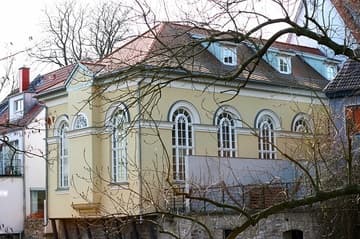
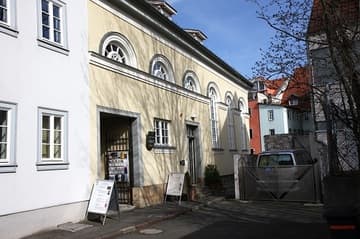
The Kleine Synagogue is a pale-yellow classical building on the bank of the Gera River, very close to the Krämerbrucke.
/ Germany / Kleine Synagoge
Sacred site · 1840
This small structure from 1840 is the oldest undamaged synagogue left in Germany. It now houses an exhibition on Erfurt's Jewish community.
The Kleine Synagoge (Small Synagogue) in Erfurt is the oldest undamaged synagogue left in Germany. It now houses an exhibition on Erfurt's Jewish community.
A Jewish community has been documented in Erfurt since the 12th century, but some think it could date back to as early as 742, when the bishopric of Erfurt was founded. More than 100 Erfurt Jews were killed in the Black Plague massacres of the early 1300s and the survivors were not allowed to return until around 1350.
The synagogue of Erfurt was built in 1357, near the important river crossing at the Merchant's Bridge (Krämerbrucke). The Jewish community prospered until the end of the century, when King Wenceslas impoverished it with special taxes and moratoria.
The Jews were expelled from Erfurt in 1458 and not allowed to return until the 19th century. A new building, the Kleine Synagoge, was built in 1840 right next to the ruins of the original Gothic synagogue.
The Kleine Synagoge was the place of worship for Erfurt's Jewish community until 1884, when a larger synagogue was built and the old building was sold. The Kleine Synagoge was subsequently used as a vinegar factory and later (1918) partitioned into apartments.
Thanks to these private uses, the Kleine Synagogue was not recognizable as a synagogue on Kristallnacht in November 1938 and was therefore left alone by the Nazis. The 1884 synagogue, on the other hand, was burned to the ground and not rebuilt until 1952.
After a century of private use, the Kleine Synagogue was purchased for the purposes of restoration in 1993. Happily, both the women's gallery and Torah shrine were discovered fully intact behind the walls. The synagogue was completely restored and opened to the public as a museum in 1998.
More than 100 Erfurt Jews were killed in the Black Plague massacres of the early 1300s and the survivors were not allowed to return until around 1350.
A Jewish community has been documented in Erfurt since the 12th century, but some think it could date back to as early as 742, when the bishopric of Erfurt was founded.
The Kleine Synagogue is a pale-yellow classical building on the bank of the Gera River, very close to the Krämerbrucke. The main level houses the restored prayer room of the synagogue, including a women's gallery, wooden Torah shrine and Hebrew inscriptions.
The basement contains a display on Erfurt's Jewish community and a small stone mikvah (ritual bath). The synagogue also hosts such events as exhibitions, lectures, readings, concerts and conferences related to Judaism and religious tolerance.
Part of a wall from the original Gothic synagogue can be seen nearby, embedded in a wall of the Feuerkugel Restaurant on Michaelisstrasse. One of the smaller rooms in the restaurant may be part of the synagogue complex as well.
Highlights from Sacred Destinations
Highlights from Sacred Destinations
Advertisement
Advertisement
Advertisement
Where on earth