Highlights from Sacred Destinations
Explore the site
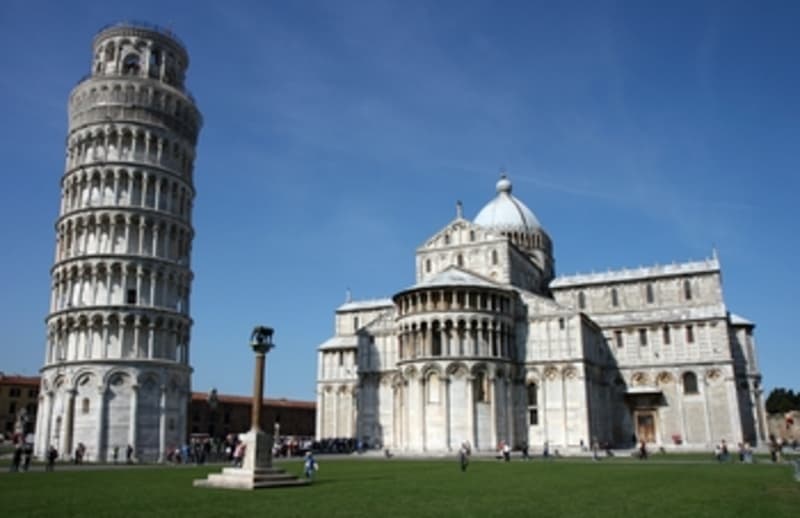
The fine marble facade of cathedral is in the "Pisan Romanesque" style that can also be seen in Lucca and other Tuscan cities.
/ Italy / Pisa Cathedral
Sacred site · 1093
Begun in 1093, Pisa Cathedral is a masterpiece of Romanesque architecture. Its marble exterior is covered in rhythmic arcades and the interior boasts important works of art by Pisano and others.
Begun in 1093, Pisa Cathedral (Duomo di Pisa) is a masterpiece of Romanesque architecture. Despite its proximity to the eye-catching and tourist-attracting Leaning Tower, the Duomo still dominates the monumental Piazza dei Miracoli in Pisa.
The first stone of Pisa Cathedral was laid in 1093, initiating what would become the distinctive Pisan Romanesque style. The main architect was Buscheto, who is buried in the last blind arch on the left side of the facade. The facade itself was built by Buscheto's successor, Rainaldo.
A disastrous fire in 1595 destroyed most of the cathedral's medieval art, but some of the best Renaissance artists were hired for the redecoration work.
The first stone of Pisa Cathedral was laid in 1093 , initiating what would become the distinctive Pisan Romanesque style.
A disastrous fire in 1595 destroyed most of the cathedral's medieval art, but some of the best Renaissance artists were hired for the redecoration work.
The fine marble facade of cathedral is in the "Pisan Romanesque" style that can also be seen in Lucca and other Tuscan cities. The bottom section has tall blind arcades with pastel-colored marble inlay and three portals with bronze doors. Above this are four rows of open arcades with delicate columns and Moorish-inspired arches, rising to the top of a gable that is much taller than the cathedral roof.
In summer, entrance is sometimes via the main door, which is one of three cast by students of Giambologna after the 1595 fire destroyed the originals. The usual entrance to the Duomo is in the south transept near the Leaning Tower, which is home to the original bronze Door of San Ranieri, cast by Bonnano Pisano in 1180 while he was working on the tower.
The spacious nave has a Cosmatesquemarble pavement and two aisles on each side; the transept crossing is covered by a painted oval dome. Due to the 1595 fire, the interior is mostly decorated with Renaissance art, but there are also some fine medieval survivals. One of these is the Tomb of Emperor Henry VII by Tino di Camaino (1315; with a pair of angels by Ghirlandaio) in the south transept. The Ghibelline Pisans enthusiastically supported Henry VII's ascension to the post of Holy Roman Emperor.
Another exceptional artwork from this era is Giovanni Pisano's pulpit (1302-11), widely regarded as a great masterpiece. It was not always so popular, however. Those who undertook the renovations after the 1595 fire thought the old Gothic pulpit was an eyesore, so they dismantled it and stored it in a crate. It was not rediscovered until 1926; it was reassembled and once again occupies its original place on the north side of the nave.
Near the pulpit is a low-hanging bronze lamp that, according to a popular story, Galileo was watching sway gently during Mass when the law of the pendulum occurred to him. Sadly, the lamp was actually cast in 1586, a few years after Galileo's discovery, but another lamp almost certainly hung here before this one.
The bronze angels (1602) flanking the entrance to the choir were shaped by the baroque bronze master Giambologna. Gracing the entrance pier is Andrea del Sarto's St. Agnes with her Lamb, painted in High Renaissance style. The crucifix over the altar is by Giambologna. The apse is decorated with a huge 13th-century mosaic of Christ Pancrator. It was completed in 1302 by Cimabue, who also added St. John the Evangelist on the right.
Highlights from Sacred Destinations
Highlights from Sacred Destinations
Advertisement
Advertisement
Advertisement
Where on earth